
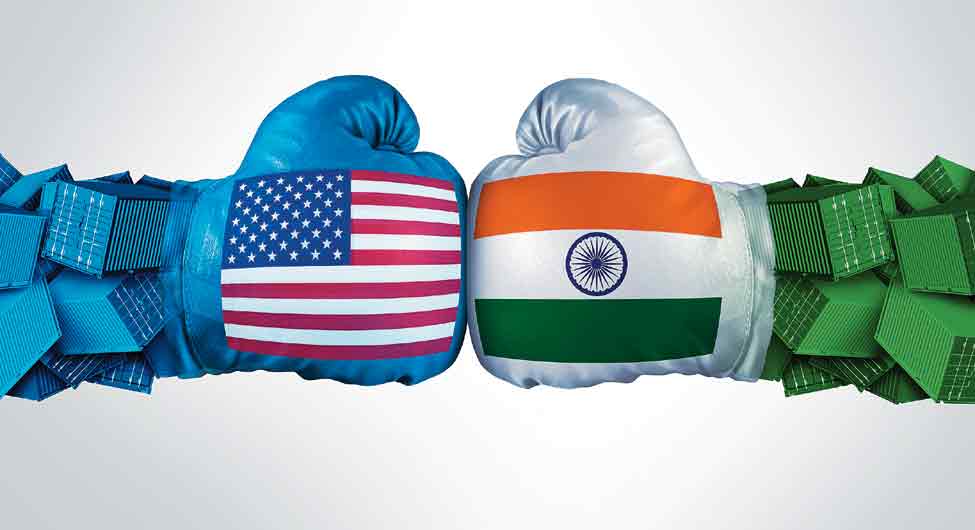
India can withstand 25 percent tariffs, it may not have much effect, but 25 percent penalty tariff will be difficult.
The Indo-US relations have been given unnecessary blow by Donald Trump. After the 2005 nuclear deal, the faster in relationships during the tenure of three different presidents, whether Republicans or Democratic, was based on the importance of these relations at both bilateral and geo-political levels.
This made America India’s largest trade and investment partner. Defense relations expanded, advanced tools and technology export controls for India were gradually relaxed, initiatives were initiated for emerging techniques under the chairmanship of National Security Advisors of both sides.
The quad was formed to prevent Chinese expansionism in the Western Pacific and the Indian Ocean. This emerged the Indo-Pacific concept, which added the safety of the Pacific and the Indian Ocean. The US changed the name of the Pacific Command to the Indo-Pacific. The foundation of a long -term relationship based on shared interests and increasing beliefs is being laid by these things. The US began to define the strategic partnership with India as a decisive relationship of the 21st century.
During his first presidential tenure, he and Narendra Modi formed close personal relations. India made a remarkable debut, when Trump welcomed Modi at the White House in February, within a few weeks of his swearing in. The two sides were successful in releasing a very concrete joint statement, which included all major initiatives initiated during the Presidential tenure of Biden, especially in the field of technology. It was agreed that the two sides would work on an interim agreement on trade and talk on multi-regional trade agreement by autumn, which would be signed to come to India for Trump’s Quad Summit.
The purpose of this interim agreement was to divert attention from the issue of fees, which became the center of Trump’s foreign policy. He announced a fee on almost the world without any logical base, which would incur 27 percent fee on India. He gave other countries a deadline as an effective ultimatum to propose to reduce its tariffs, so that the US could decide the final tariff amount on their exports to the US. This was his art of bargaining, his strategy to increase stress and reduce.
The Indo-US interim agreement was intended to complete Trump before Trump’s time limit, which included five round of talks, which India gave concrete concessions, as a result of which a lesson was prepared, which was clearly acceptable by the United States business representative (USTR). Trump decided not to approve the lesson as he wants to open the Indian market completely or almost the whole. After persuading the European Union (EU) and Japan on unilateral agreement, Trump may have felt that he could scare India too, especially in terms of opening agriculture and dairy areas, which is like the Lakshman Rekha for India.
Like China’s case and without waiting for talks, Trump went ahead and announced a 25 percent tariff on India, the highest among the Asian economies. He has decided to put a 25 percent additional tariff on the purchase of Russian oil and defense equipment by India, moving beyond the trade issue. He has re -raised the pressure of the Biden round to stop the oil purchases on India after military intervention in Ukraine and reduce defense relations with Russia. India had opposed it at that time and the Biden administration did not make it an issue given the imperative of its geopolitical priorities in Asia, which Trump is ignoring.
Trump’s punishment is an attempt to limit India’s freedom to adopt independent foreign policy in view of India’s important national interests. Russian oil is not banned. Although there is no validity of the value limit of Russian oil, India is buying Russian oil within this border. That too, as we have officially stated, with the encouragement of the US to maintain stability in global oil prices, because keeping dandruff out of the market could have dramatically increased international prices and could also cause damage to American consumers.
There is also a personal aspect in Trump’s bullying towards India. He has been unnecessarily insulting India, calling it a dead economy.
Immediately after the Pahalgam attack, by praising the Pakistani leadership, inviting the Pakistani Army Chief, who has a Pakistani army chief for lunch at the White House, by proposing mediation on Kashmir, by giving up the Kashmir issue and re-airing the Kashmir issue and talking to the Pakistani army chief, Modi (where he was participating in the G-7 meeting) by trying to invite was a washing Sensitivity is shown. A Crypto deal with Pakistan by Pakistan’s Army Chief, which has financial interests from people close to Trump and the deals proposed to exploit Pakistan’s mineral and oil resources have further promoted Tram’s softening of Pakistan.
Trump’s Finance Minister Scott Besant has threatened that if the Alaska talks between Trump and Putin fail, India will be fined even more tariffs. Now landscape Washington D.C. The transfer in, where Trump Volodimir is interacting with Volodimir Jailonsci and leading European leaders to prepare future progress plans to reach the peace agreement, whose future is uncertain, given the tough stance of Jailonski and European people. They also want the European Union to impose secondary sanctions on India. The European Union has already banned Nyara Energy in India, with Russia’s Rosneft stake. Former USTR Peter Navaro is also inciting Europe to impose secondary ban on India. Why should India be made a sacrifice of sacrifice for the US failure to resolve the Ukraine issue, which America had a central role in construction, is beyond comprehension.
China is the largest buyer of Russian oil. The US and Europe accuse China of giving military assistance to Russia, even arguing that Russia cannot continue its military campaign without Chinese help. Nevertheless, Trump has not fined China. Actually, he has bought the tariff dialogue with China for 90 days further for himself.
Despite the ban on Russia, the European Union is still buying a large amount of Russian LNG as well as oil and petroleum products. NATO member is the largest buyer of refined petroleum products from Türkiye, Russia. The US also buys uranium hexaphloride, palladium and titanium from Russia. Japan is also importing Russian LNG from Sakhalin 2 project. Attacking India is a disgusting experiment of double norms.
India intends to face Trump’s provocation peacefully, keeping in mind the long -term relations with the US. He will try to continue business normally. The delegation level trips seem to continue. India will definitely carry forward its basic interests, but will avoid any kind of debate with Trump. India will maintain its close relationship with Russia. Putin’s proposed visit to India this year will give him a new incentive.
India may probably bear 25 percent of tariffs because it has many discounts. There will be no significant impact on our economic growth. We are not highly dependent on exports. Despite Trump’s tariff, S&P has improved our credit rating. We have to see that 25 percent penalty tariffs will not be imposed after some progress in Alaska.
In any case, Trump’s arrival in India seems to be almost impossible for the quad summit to be held in India in this autumn. Therefore, the quad summit is likely to be postponed.
(Former Foreign Secretary and Ambassador to Russia, views are private)