Youth generation has a new way to carry out disagreement, digital rebellion is becoming a challenge for power
Restrictions create rebellion, its history is centuries old, and there are many examples of big movements and the transformation of power. But the spread of social media, its reach, its diversity is so wide that if you ban some of its platforms, the other platforms become equally effective and its ping (speed or bounce) is so tremendous that the power speed also gets smaller in converting the spark of quick gathering and rebellion. In this sense, the story of Nepal sets a new example and is shocked by the innovation of social media use.
In the recent years, social media was used in Bangladesh, Sri Lanka, Indonesia, Iran and its first ‘Arab Vasant’ in the Arab world countries, there was a lot of use in large coup or governments shaking. But broadly used SMS (eg Anna movement) or Facebook, Instagram, WhatsApp or a similar traditional or more prevalent platform. So, K.P. of Nepal Sharma Oli’s government probably felt that by banning these platforms, it would suppress the dissatisfaction that is flourishing in the youth to some extent. So, on 5 September, 26 popular social media platforms were banned citing “national security and social harmony deteriorating”. Facebook, Instagram, X, YouTube all stopped. But the youth turned out to be smarter than the government. Social media provided him with immediate options. He gathered at the Virtual Community Hub Diskord of Gamers and set out the outline of protest. This is the strength and prevalence of social media, the effect of which was shown by the younger generation of 15-30 years of Nepal and this makes the story of Nepal unique.
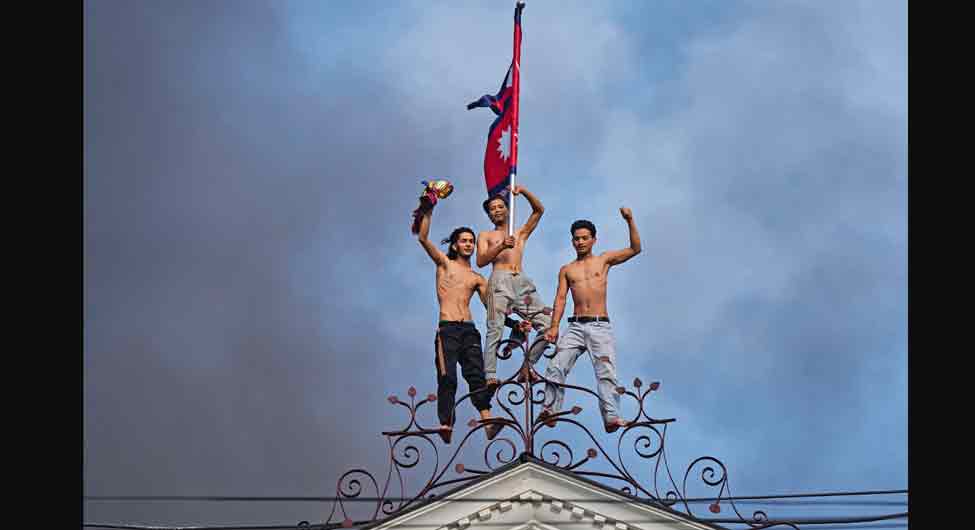
In this way, the strategies which took years, months or weeks to take it on the ground, did this in a few hours. On seeing this, hashtags like ‘No Bain in Nepal’, ‘Voice of Jane Ji, Internet Right’ started trending all over the country and the world. Thousands of youths started throwing stones at government buildings and reports of collision between police and protesters started coming in several cities including the capital Kathmandu. The roads of Kathmandu turned into war. The leaders of Oli and all the mainstream parties had to find safe hideouts.
After the ruckus: People cleaning after burning the police station of rebel youth in Kathmandu
This rebellion of Nepal is not alone. In recent years, many countries of Southeast Asia have been shaken by digital use protests of youth. In 2024, university students launched agitation for reservation policy and unemployment in Bangladesh. This wave, which started from Dhaka University, connected millions of youth in a few days. Hashtags like ‘No Kota, Job for Youth’ gave direction to the movement. Only about 50 thousand students from Dhaka University took to the road. Sheikh Hasina had to leave the country and flee and the interim government was formed.
The 2022 economic crisis in Sri Lanka also turned into a political explosion with the digital call of youth and students. The hashtag trend like ‘Gota Go Home’ gave a slogan to the entire country’s anger. WhatsApp and Telegram groups organized thousands of people in minutes. The protest became so extensive that President Gotabaya Rajapaksa also had to leave the country. In the last four years, social media has brought out the opposition of youth in three neighboring countries of India. In all these countries, social media did the work of giving a edge to the movement.
According to a report by the World Value Survey, “In the last two decades, a large number of ordinary citizens have taken to the road, at the forefront of students and youth.” The desire to participate in demonstrations in the youth has reached the highest level since the 1990s and the number of protests has also increased during this period. ‘
“Nepal has been protested before in Nepal, such as the mass media department’s Head Nirmal Mani officer of Kathmandu University, Nirmal Mani officer Outlook, such as the mass movement or the Madhes movement. But the old methods were adopted in it. His speed was slow. The spread of information was newspapers, TV channels or mouths, which used to take weeks. This time the situation was different. The movement reached its peak within just 24 to 48 hours, as social media immediately reported. When the government suppressed the youth, the news became viral in the blink of an eye, causing the number of protesters to increase rapidly. ”
In the recent years, the power of digital disagreement in India has also been seen repeatedly. The Kisan Movement of 2020-21 was an example of this. The siege and police collision on the border of Delhi was livestroke by the protesters, photos and videos went viral on Twitter and Facebook and became the Hashtag Farmer Protest Global Trend. Actresses like pop singer Rihanna also tweeted on the issue.
Similarly, the anti-CAA movement against the Citizenship Amendment Act did not depend on the dharna of Shaheen Bagh. Twitter campaigns, viral Instagram reels and Facebook posts coined such an atmosphere that it directly began to look like a fight to save the constitution. The hashtag ‘Me To India’ movement put disagreement in a completely new form. It was not in the road or ground of a city, but was completely online, in which thousands of women shared their experiences of abuse. He forced political parties, universities and companies to take action.
The same pattern appears globally. Ten years ago, Arab Spring proved that Facebook page and Twitter threads could also get coup. In the 2019 Hong Kong protests, the youth made technology a weapon. He dodged police strategies using Telegram Group and Encrypated Chat. Millions of crowds hit the road. The movement was against the Extraction Bill of the China -backed Hong Kong government, under which the people of Hong Kong could be sent to the mainland China to face the cases. Later, the government had to withdraw this bill. In the US too, the Black Lives Matter movement began against the police barbarity and racial discrimination. Due to millions of tweets and Instagram posts, it became one of the biggest movements in the history of America.
The USIP -based USIP’s 2023 report says that the participation of youth in demonstrations between 2015 and 2019 reached 50 percent. The report said that the youth are also getting success in their movements, because the youth give priority to informal politics rather than the politics of mainstream. Young protesters have changed the methods of protest using digital platforms and techniques. This reduced the procession of the procession, increased participation and the movement proved to be more powerful.
The real strength of digital forums is speed and access. Today there is internet everywhere and everyone has smartphones in their hands. According to a report by Statta, 1.2 billion people in India have internet connections and about 70 crore people have smartphones. According to a report by PU Research, globally, more than 80 per cent of people in the age of 15-24 years use the Internet while in high-age countries it is about 95-99 percent.
The smartphone and the Internet have almost eliminated the obstacles of the movement. Anyone can become a part of the movement by sharing a post or making his own asset. “Earlier the leaders of protest were usually some people,” says Uddhav Pyakural Outlook, an expert and political sociologist at Indo-Nepal relations. But now the leadership has become decentralized; No one charismatic leader is the face of the movement, but thousands of small organizers are advancing it in their respective groups, chats and networks. “He further says,” The police could first tear or arrest the police poster, but today a video becomes so many times that it is difficult to decide the accountability of one. “
However, the threat of rumor in digital movements also remains constant. A false rumors in Bangladesh provoked unnecessary violence. At the same time, the attack on Capital Hill in Washington DC in 2021 was also provoked due to fake news and misleading information on social media. On the one hand, the digital platform has the ability to strengthen democratic disagreement and civil participation, on the other hand, it can also destabilize them with the same strength.
There is another thing with social media, which shows its negative side. Many times, the faster the hashtag goes on, the faster it also cools down. It is also called “Slacturalism”, where people only change their profile picture or post a slogan and understand that they contributed to the struggle.
There is another aspect of this. According to UNICEF, “Digital disagreement achievements often do not change in solid changes for a long time.” Demonstrations can be dropped immediately, but concrete reforms on issues like employment, education, women-men equality or social justice are often pending. ”
Sudan’s movement is an example of this. In Sudan, there was a agitation focused on the demand for restoration of democracy, ending military rule and establishment of a civil government in 2019. After a long struggle, President Omar al-Bashir was removed and a temporary civilian-monkey shared government was formed. But the most important demands of the youth-permanent democratic structure, employment, education and women-men were not fulfilled in equality. The youth in new power structures were excluded from the decision -making process and in 2021 the military coup completely demolished these expectations. The main demands of 2024 student movements in Bangladesh, improvement of reservation policy in government jobs and increasing employment opportunities for youth. But no concrete changes were made on any of them.
For big democratic countries like India, this phenomenon brings both opportunity and danger. On the one hand, a young population equipped with smartphones can make any issue an issue of national discourse. Movements like climate crisis, Dalit rights or women-men justice are no longer dependent on local newspapers or TV debates, X and Instagram directly bring them to the national level. During the epidemic, the volunteer network, which was built for oxygen and severe lack of hospitals, showed that digital technology could accelerate both system of protest and relief work.
Nepal’s hashtags cannot change the law in themselves, but the same hashtag may force leaders to retreat, attract the attention of courts and intervene to the international community. Now disagreement does not only depend on who is marching on the road, but also on who is posting what, what is sharing, the battle between disagreement and power is as much in digital space as on the land.
That is, social media has almost finished the need to hold a risky secret meetings by distributing pamphlets from house to house for protests, meeting in the rooms of student hostels, nor is the walls of colors with slogans. The digital age changed the entire definition of revolution. However, digital forums also intensified the edge of politics and Bhothra. For example, the medium through which the leaders shine their image, won elections, wooed voters, their polls were opened and they were unabated. The society has understood its strength and has completely changed the structure of power. This structure changed so much that the foundation of power of many countries shook.
Social media movement
The role of social media was important during the peasant movement in India in 2020-21
The campaign on Twitter, Facebook, Instagram in the Anti-CAA movement against civil amendment law gathered crowds
In Sri Lanka also the economic crisis of 2022 turned into a political explosion with the digital call of youth and students
‘No Kota’, ‘Job for Youth’ hashtag went a lot in the university students’ movement in Bangladesh in 2024
First of all, Arab Spring proved that Facebook page and X Threads can get the government coup.