With the announcement of 50 percent tariff of Trump, why did Modi government’s foreign policy fall down
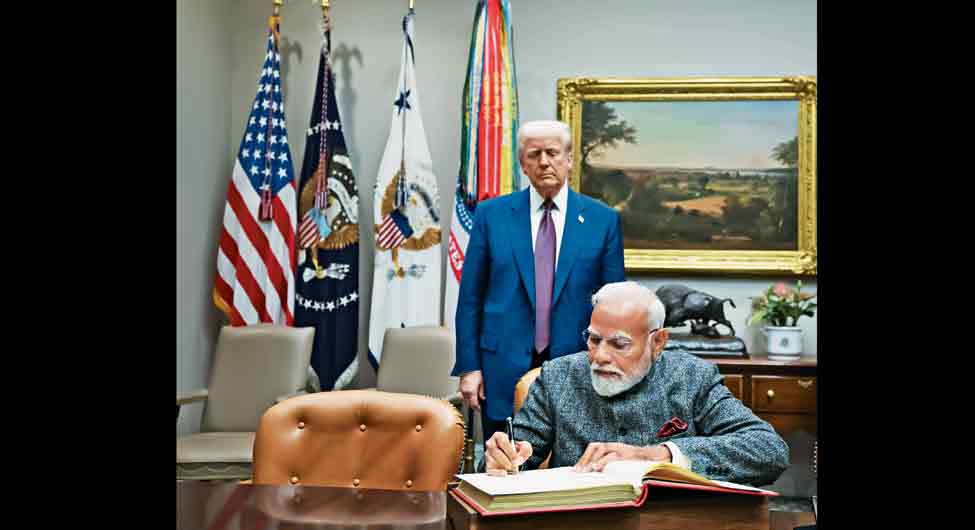
The central government, led by the Bharatiya Janata Party (BJP), has been increasing its strength in domestic politics by beating its success on the foreign policy front. The image was publicized that Prime Minister Narendra Modi sits in the huge sky of global forces and is holding meetings with powerful leaders such as US President Donald Trump, former President Barack Obama and Chinese President Xi Jinping. In 2015, when Obama was the President and came to India as the chief guest at the Republic Day parade, Modi broke the diplomatic protocol and addressed him with his first name Barak. Whereas Obama in return called Mr. Prime Minister in a formal diplomatic and slightly different style.
However, unlike many right -wing popular leaders, Modi has been cautious in his international statements and has been trying his best to speak in a restrained tone. For example, in the year of Russian invasion of Ukraine, see his statement that “it is not a war of war.” It was seen as an example of the enlightened elderly politician giving a discourse on the world position. This is contrary to his more stringent statements on the domestic front, when he suggested in 2019 that those who protest against the Citizenship Amendment Act (CAA) could be identified with their clothes, indicating their religious identity.
A component of alleged success on the foreign policy front has been a series of Modi’s foreign visits, where he has expressed a sense of purpose to establish India on a global stage. The big part of this success is Foreign Minister S.K. Jayashankar is associated with professional diplomats and can speak the language of international diplomacy efficiently, as well as the ability to express some specific policy elements of Modi rule. When Jaishankar was asked about India’s position on the Russian invasion of Ukraine at the Globesch 2022 Forum in Slovakia, he said that Europe should stop looking at its problems as the world problems.
Three contradictions of Modi’s foreign policy
The announcements of India’s foreign policy have been fade by the announcement of Trump’s 50 percent tariff. According to India, the purchase of cheap Russian oil is one of the reasons for this. Perhaps Trump is angry with India’s official reactions, refuting his claim that he had a ceasefire between India and Pakistan in May this year. Or is that India has not supported his nomination for the Nobel Peace Prize like Pakistan. Except for personal ego, there is a underlying weakness in the basic structure of BJP rule’s foreign policy. The successes aired on the platform of foreign policy include three different elements, which are now against each other. First, growing close proximity to America and aligned with it. Second, revival of traditionally with Russia revival with Russia soon after Russian military operations against Ukraine starting from February 2022. Third, India’s claim on the leadership of the global South and the membership of the BRICS. The first element continued for the longest a long time, which began with Modi becoming Prime Minister in 2014, which continued in Obama’s last two years, Trump’s first presidential post and Biden’s first year of Presidential President.
The growing proximity with the US has a long background, when we consider how the US banned it in 1998 due to India’s Pokaran nuclear tests. This trend reversed when India became the new ally of Washington when the global war against terrorism started after 9/11 attacks in 2001. India still remained a friend of Washington when the Atal Bihari Vajpayee government lost in the 2004 elections and was followed by a United Progressive Alliance (UPA) government led by Manmohan Singh, which signed a civilian nuclear agreement with the US in 2008.
Trump’s first term confirmed this growing coordination between the US and India, with Modi being held as Prime Minister. The upcoming Democratic Biden administration put a brake on this harmony, which Modi worked hard to announce, especially in September 2019 with his ‘Houdi Modi’ program in Houston, Texas, where he raised a famous slogan in front of the spectacular audience, “This time, this statement became a codal burden because it became a codal burden in 2020 because it was a renewal of the President of the President in 2020. It seemed support. This harmony was felt even more brakes when the Biden administration hoped that India would support West in Russia of Putin for military operations in Ukraine. India objected to this and instead started importing Russian oil at concessional rates. This indicated the arrival of the second element of the three elements mentioned above, Modi’s foreign policy revived the familiar glow of melodious relations with Russia, reminding of the cold days of the Cold War.
America’s expectation that India will stand with the US -led democracy against Putin’s autocracy and India’s favorable inclination towards Russia, when India did not participate in voting on the proposal to suspend Russia from the 47 -member Human Rights Council in the United Nations General Assembly in early April 2022, Modi’s supporters of Modi’s foreign policy thought that there was a strategic benefit. Three years later, Trump’s declaration of tariff was punished for buying Russian oilHas come in form.
Trump has stepped on the path of punishing India, there is a way on which the Biden administration did not step. The US Deputy National Security Advisor (International Economics) Dalip Singh, who visited India at the end of March 2022, said that the US would not decide any ‘red line’ for India on the issue of cheap Russian oil imports, while he clearly indicated that the US does not want to see ‘fast pace’. Jaishankar gave a diplomatic answer, which has made him a favorite of the Indian middle class supporting the Modi government, when he quipped, “Perhaps, our total shopping will be less than the purchase of Europe in one afternoon shopping this month.”
Trump’s tariff is expected to have a bad effect, which will affect many Indian cottage, small and medium enterprises (MSMEs), from the foundry making steel and aluminum parts to the diamond carvings in Surat, which exports to American. Nevertheless, the Government of India’s response has been contrary to that. Modi has called Brazilian President Lula Da Silva and is scheduled to visit China for the Shanghai Cooperation Organization Summit in late August. This reaction highlights the third aspect of Modi’s foreign policy, which is to underline India as a leading part of the global south, especially the BRICS membership.
Right to history
The Indian foreign policy led by Modi has become an exception to the solidarity shown by BRICS members Brazil and South Africa, generally global south and especially BRICS members. The BJP rule is in danger due to the lack of strict rejection of the emergency actions by the BJP rule, to resort to this third aspect of global South membership and leadership. Amidst generally silent response to Indian leaders on the ongoing massacre in Gaza, Congress MP Priyanka Gandhi recently made her own identity by speaking against the killing of four journalists of Al Jazeera by Israel.
Modi’s foreign policy, after claiming a big success for years, especially with Donald Trump through ‘brotherhood’, now looks directionless. The overwhelming claims of India’s imminent greatness in the world have been made by creating a melodious sound of success abroad. The eismly Prime Minister Benjamin Netanyahu, who justifies his military action for the elimination of Hamas in Gaza, to those who oppose the ejraeli action in American university complexes, everyone claims that they are on the right side. The makers of Modi’s foreign policy should think about this, especially in the context of the heritage they will leave behind them. The best way to find the right side of history is to remember that it is the bread on which butter is not applied with the power of power.
(Professor at Center for Political Studies at JNU, ideas are private)