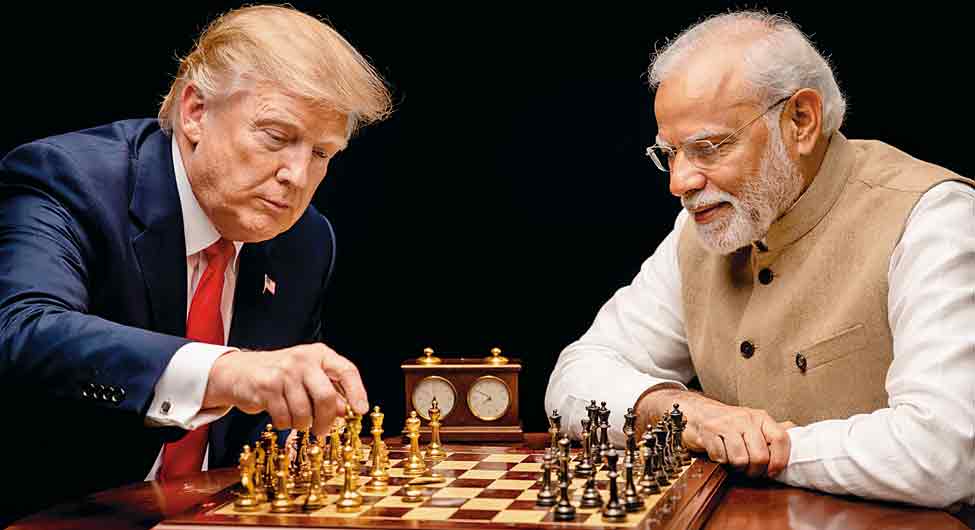
Illustration: Rohit Rai/AI
Finally, on February 6, the interim joint draft of India-US Free Trade Agreement also came and US President Donald Trump also signed the executive order that 25 percent tariff is being removed as a penalty on India because it has promised to stop buying oil from Russia. But the order warns that four US departments will keep a close watch on him so that if he does not live up to the promise, he can be fined again. The amount of fine will also depend on the then assessment. Well, after months of tussle, dispute, etc., suddenly on February 2 at 9 pm (in India), US President Donald Trump wrote on his social media truth social, “It is an honor to talk to the Prime Minister of India Modi this morning. He is one of my great friends and a powerful and respected leader of his country. Out of respect and friendship for Prime Minister Modi, at his request, with immediate effect, we agreed to a trade agreement between the US and India, under which the US will reduce mutual tariffs from 25 percent to 18 percent. There will be zero barriers and tariffs on exports of American energy, technology, agricultural products, coal and many other goods. India has stopped buying oil from Russia and will buy oil from America and especially Venezuela. India is ready to buy American goods worth 500 billion dollars.
After that, at around 11 pm, Prime Minister Narendra Modi expressed gratitude to “his dear friend”. The next day, Commerce Minister Piyush Goyal came to tell that we have not made any compromise on agricultural produce and sensitive issues. However, America’s Agriculture Minister was announcing that a huge market of 1.4 billion people has opened up for America’s farmers. On the same day, in the meeting of NDA MPs, the Prime Minister was praised for the agreement and the agreement was described as important towards the goal of developed India. But the opposition called it a complete “surrender” of India. Opposition MPs raised slogans of “Narendra surrender” in the Parliament complex. There was no detailed information from the government, because everything was coming from America. Because of this the confusion remained till the end. Even in Washington on the evening of April 5, Foreign Minister S. Jaishankar told reporters that only Commerce Minister Piyush Goyal will tell about the agreement, because I am not associated with it. But after the release of the interim joint letter on April 6, when Piyush Goyal was asked in a press conference about the purchase of oil from Russia, he replied that it is a matter of the Ministry of External Affairs.
Partnership: Jaishankar with US Secretary of State Marco Rubio
This confusion can be cleared up only by looking at the available information so far. But before that, it is important to know that this is still interim and broadly its purpose is to prepare a broad basis for Trump to issue an executive order to remove the penalty tariff from India. After this, there are indications that a detailed joint letter will come out by March-April. Bilateral talks will be held on that basis, then detailed details will be revealed openly. This may take several months. Let us see what is revealed from the details so far.
India’s concessions
These are the concessions, information about which is recorded in both the documents released so far. India has promised not to directly or indirectly stop importing crude oil from the Russian Federation, but has significantly reduced it in the last few months. This is India’s biggest strategic or rather the freedom given in terms of taking its own decisions. India currently imports about 12–15 lakh barrels of oil from Russia every day, which is about 25–35 percent of its total consumption. Russian crude Brent is $7–12 per barrel cheaper than US crude. Buying expensive oil from America and other countries will increase India’s annual oil import bill by about $9-12 billion. This burden will fall on the people through the prices of fuel and fertilizers. The special thing is that ‘Section 4’ of the executive order of the US President talks about continuous monitoring system. The US Commerce Minister will keep an eye on whether India is importing oil from Russia “directly or through any other route.” This means that India’s energy autonomy will now be under constant US surveillance. In a sense, this is like India handing over veto power to Washington on its energy purchases.
Then, India has agreed to buy goods worth $500 billion (probably in 5 years). Under this, American energy products, aircraft, precious metals, technology products, agricultural products and coal are to be purchased. India’s current annual imports from the US are approximately $46 billion (FY25). This promise means that approximately $100 billion will have to be purchased every year, which is 118 percent more than the current level. This goal is much higher than stopping oil from Russia and its impact on our economy is certain.
agricultural issue
India will “eliminate or significantly reduce” tariffs on a variety of food and agricultural products from the United States. India’s current agricultural tariffs are among the highest in the world (an average of 64 percent, with duties on meat, fruits, vegetables, and grains exceeding 100 percent). These tariffs were specifically imposed to protect India’s more than 40 crore farmers, 86 percent of whom are small and marginal farmers with less than 2 hectares of land. Let us see in which agricultural produce and products India is opening the market:
• Dried Distillery Grains (DDG): This will have a direct impact on maize, soybean etc. in India for animal feed. American DDGs are much cheaper and will replace soybean farmers’ market in India.
. Soybean Oil: Oilseed farmers in Madhya Pradesh, Maharashtra and Rajasthan will be affected.
• Tree nuts (almonds, walnuts, pistachios): Farmers of Kashmir and Himachal Pradesh will be greatly affected, as American goods will be much cheaper. These crops are the source of livelihood for small farmers doing hill farming.
• Fresh and canned processed fruits: Their open influx will impact apple, grape and citrus fruit farmers in the country.
• Wine and Liquor: Competition with America will affect the domestic sector.
• Red tide: There will be a direct impact on the farmers growing fodder in the country.
There is also a case in point that all these agricultural products will largely be GM crops, which are banned in India till now.
Eliminate non-tariff restrictions
India has agreed to remove long-standing non-tariff barriers to US medical devices within six months, eliminate restrictive ICT import licenses and ensure US standards are accepted. This is a matter of giving up our regulatory autonomy. This will weaken the country’s domestic medical device manufacturing program (Make in India) and indigenous standards. Accepting American standards means that the certification system of the Bureau of Indian Standards may become redundant or weak.
Apart from this, the joint letter states that India will “eliminate or reduce tariffs on all American industrial products.” This is a big thing. India’s tariffs on machinery (up to 44 percent), chemicals (22 percent), and other industrial inputs were a safeguard for the still-developing manufacturing sector. If it is removed, Indian industries will hardly be able to survive in the competition.
Defense Cooperation Framework (10 years)
Trump’s executive order said India has “committed to creating a framework with the United States to expand defense cooperation over the next 10 years.” However, its details are not available yet. But this could also include greater purchases of American defense goods, further distancing India from the Russian military hardware on which our military has been dependent. This is a long-term strategic change.
Policy implications of the agreement
This agreement may limit India’s free decision on future policies in policy matters. Although the reciprocal tariff dropped from 25 percent to 18 percent, this is hardly a “free trade” arrangement. India’s main labour-intensive export sectors (textiles, leather, footwear, plastics, home decor, handicraft goods) still face 18 per cent US tariffs. The promise of zero-tariff for gems, diamonds, generic pharmaceuticals and aircraft parts is conditional. That requires “the success of the interim agreement,” and in medicine, it is “dependent on the outcome of an investigation under Section 232 of the US Act.”
Differences in “Amendment” Clauses
The joint letter said that if either country changes its fixed tariffs, the other “may change its commitment.” On paper it looks like a tie. But, America has more advantage. India is dependent on exports, and the US can impose a 25 percent penalty tariff at any time. India’s ability to retaliate is limited for several reasons. The basic rules promise to be such that the benefits “go to America and India.” This sounds fair, but it limits India’s ability to act as an export hub for third country goods (especially sugar). This will create obstacles for India to join the Asian supply chain.
The two countries agreed to “strengthen economic synergy” with cooperation on “investment review and export controls among themselves and each other” and “changes in non-market policies towards third parties”. This is diplomatic language of not joining forces against China.
digital business rules
India promises to “eliminate discriminatory or burdensome practices and other barriers to digital trade.” India’s data localization requirements, digital services tax proposals and platform regulation have all been US complaints. This clause indicates that India will soften its digital autonomy stance in favor of open-data systems favored by the US, which will benefit US big technology companies.
benefits to india
However, many of the benefits come with or after conditions. The reduction in tariff from 50 per cent to 18 per cent is undoubtedly quite significant. Indian exporters of textile, leather, footwear, chemicals and handicraft products get better prices in the American market. At 18 percent, India’s tariff rate is now lower than Bangladesh (20 percent), Vietnam (21 percent), and China (30 percent), giving Indian exporters an edge to compete in the world’s largest market.
If the interim MoU is finalized, there could be zero tariff on gems, diamonds and generic medicines. India’s gems and jewelery sector (which employs about 50 lakh people and accounts for about 16 per cent of exports) and pharmaceutical sector may benefit. However, this is still dependent on ongoing negotiations.
Removing Steel, Aluminum and Copper Tariffs
US tariffs imposed on steel, aluminium, copper and Indian aircraft parts will be removed. India will also get a tariff rate quota for auto parts. This could benefit India’s growing aerospace and motor parts industry.
access to technology
The promise to “significantly expand trade in technology products, including GPUs and other accessories used in data centres”, is a strategic imperative for India’s AI and digital infrastructure. Previously, access to American semiconductor and computing hardware was restricted due to the export control system.
Framework for Future Negotiations
The US “has confirmed that it may consider India’s request for further tariff reductions during bilateral trade negotiations.” However it is not binding. The entire framework is designed as a step towards a larger bilateral trade agreement.
terms of trade
tariff on indian goods
First
Free to buy oil from anywhere
Average 2.4-3 percent tariff on exports to America
initial trump tariffs
25 percent penalty on buying oil from Russia
Reciprocating tariff 25 percent
after the interim agreement
25 percent fine removed
mutual tariff 18 percent