Increase in American investment and distance from Russia-China is also important in the country’s strategic inclination.
The risks and dangers usually lie in the details. Right now there is an indication of direction in the interim joint paper. Yet, whenever this India-US trade deal is finally finalized, its impact will go well beyond just trade and tariffs into the geopolitical realm. India may not announce a complete departure from its old balancing approach in international relations and strategic autonomy will continue to be emphasized in public statements. But in reality, New Delhi seems to be moving closer to Washington, not only for investment and access to the US market, but also in terms of strategic posture and China’s growing power along the 3,488-km disputed border.
Actually, this trend started about 25 years ago. India-US relations got a boost after Bill Clinton’s visit in 2000 and India-US nuclear agreements were signed during the tenure of Manmohan Singh. Last year, bilateral relations were dealt a blow due to America’s inclination towards Pakistan after Trump’s tariff war and Operation Sindoor. Now, a new chapter of cooperation has begun with the announcement of a trade deal and reduction in tariffs from 50 percent to 18 percent.
India’s former ambassador to the United Nations, Syed Akbaruddin, without naming China, said, “The importance of this deal is also at the geopolitical level. This will provide some support to India in bearing the tension on the northern border, will facilitate technology transfer and will also ease the situation of neighboring countries.
America is also very important for India’s economy. New Delhi needs American investment and technology to create jobs and expand trade, so that India can become a developed country by 2047.
The rise of China as an economic and military power ready to challenge American supremacy is a major reason for Washington and New Delhi to come together. Retired diplomat Anil Badhwa says, “America considers India important in its China and Indo-Pacific region strategies. Therefore, there is a strategic compulsion for both of them to be together.
China’s aggressive stance against India has forced New Delhi to look towards Washington, which resulted in a military confrontation in Ladakh in the summer of 2020. The Quad group of America, India, Australia and Japan is an attempt to stop China. It will take more than a decade for India to catch up with China’s defense capabilities, so working with the US could help deter China’s moves in Asia.
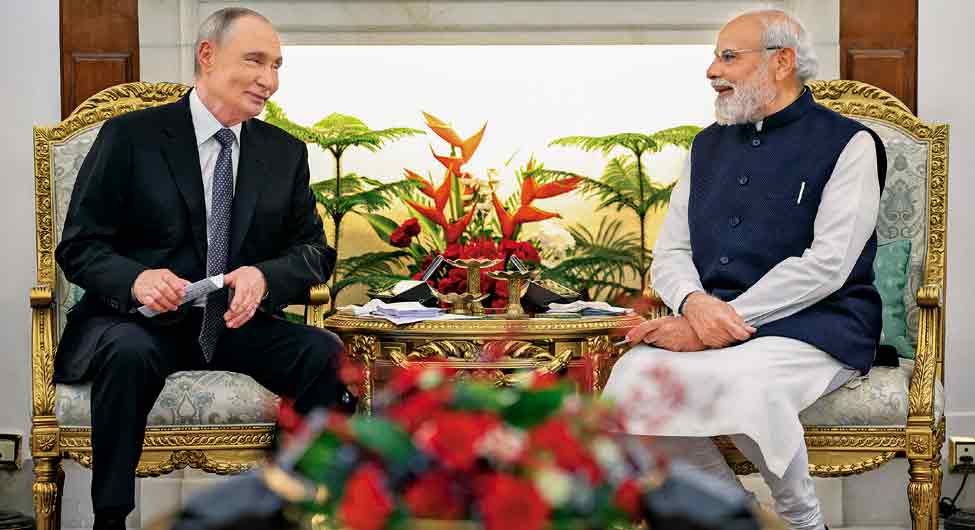
What will this do to Russia, which has been a traditional and long-standing ally of India? During Russian President Vladimir Putin’s visit to New Delhi in December, his warmth with Prime Minister Narendra Modi was clearly visible. What will happen to relations with Moscow now? Talmeez Ahmed, the country’s former ambassador to Saudi Arabia and the UAE, says, “There seems to be a broad understanding among the top political leadership in power. Russia is so deeply integrated into the Indian system that a deal with America will not make much difference. This is a unique relationship, which is not dependent on any third country.
Russia would be aware of this agreement and India’s compulsions of not buying Russian oil. Oil purchases from there have reduced significantly, yet some oil is being purchased from the private sector, which is outside the two main companies that were recently sanctioned by the Trump administration.
“There will be no major conflict, but the distance will increase,” says Nandan Unnikrishnan of the Observer Research Foundation. The two countries will continue to work together on a range of issues, including reform of multilateral institutions, UN reform, defence, space and many other key areas.
Badhwa says, “India’s relations with Russia will remain stable. The purchase of oil was necessary and facilitated by a number of factors, including deep concessions on Russian oil.”
Strategic autonomy has been the guiding principle of India’s foreign policy since independence and has benefited New Delhi significantly. But the political leadership, whether Congress or BJP, has tried to make its place in both the American and Russian camps.
However, despite the establishment’s expectations and desire to return to the old days of strategic autonomy, India-Russia relations are bound to suffer as New Delhi gradually moves closer to the US.
India will continue to maintain the balance as long as it can. However, strategic autonomy will remain a trap rather than a policy. Diplomacy can speak one language while hard international politics will decide alliances. But the question is whether America, especially the temperamental Donald Trump, can be trusted.