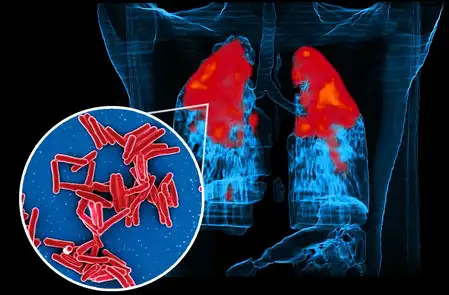
New Delhi, December 3 (IANS). Tuberculosis (TB) has been a serious global health problem for decades. IIT Bombay has conducted a study on this, which shows that the bacteria called Mycobacterium tuberculosis remains in the body for a long time by evading antibiotic treatment by changing its upper fat coating (fat layer).
Despite effective antibiotics and widespread vaccination campaigns, the disease remains a cause of death.
In the year 2023 alone, more than 1 crore people in the world suffered from TB and more than 12 lakh people died from it. India has the highest number of infected people; More than 26 lakh patients were found here in 2024.
This study, published in the journal Chemical Science, discovered that the secret of remaining unaffected by drugs may lie in the bacteria’s membranes—these membranes are complex walls made of fats or lipids that protect the cells.
The research team cultured the bacteria under two conditions: an active state when the bacteria were rapidly dividing, as in active infections, and a later state of dormancy, as is seen in latent infections.
When the research team exposed Mycobacterium smegmatis bacteria to four common TB drugs: rifabutin, moxifloxacin, amikacin, and clarithromycin, they found that the concentration of the drugs needed to stop the bacteria’s growth by 50 percent was two to ten times higher in the dormant bacteria than in the active bacteria.
Explaining this, Professor Shobhana Kapoor of the Department of Chemistry, IIT-B, said, “This means that the same drug that was effective in the early stages of the disease, in higher doses, became necessary to kill latent TB cells. This change was not due to genetic mutation, which usually occurs in antibiotic resistance.”
Decreased drug sensitivity may be related to the latent state of the bacteria and possibly their membrane folds, rather than genetic changes.
The researchers identified more than 270 specific lipid molecules in bacterial membranes using a technique called ‘advanced mass spectrometry’.
It was found that the membranes of active bacteria were loose and fluid, while those of dormant bacteria had rigid, organized structures.
“People have been studying TB from a protein perspective for decades, but lipids were long thought to be inactive components. Now we know that lipids play an active role in helping the bacteria survive and resist drugs,” Kapoor said.
The research team further tested that rifabutin can easily enter active cells, but it is difficult for it to cross the outer membrane of dormant cells.
Explaining about dormant bacteria, Prof. “The hard outer layer of the membrane becomes the main barrier,” says Kapur. “It is the bacteria’s first and most powerful line of defense.”
By weakening the outer membrane that ‘cheats’ antibiotics, their effectiveness can be increased.
Pro. “If older drugs are combined with a molecule that relaxes the outer membrane, these drugs may have a better effect,” says Kapoor. This approach can re-sensitize bacteria to the drugs without giving them the opportunity to develop permanent resistance.
–IANS
kr/