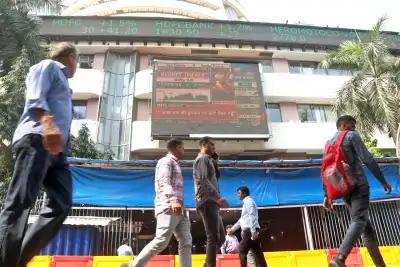
Mumbai, February 1 (IANS). Changes in Securities Transaction Tax (STT) will encourage investors to invest in the stock market for the long term. Besides, this will also increase liquidity in the market. This information was given by Sundararaman Ramamurthy, MD and CEO of Bombay Stock Exchange (BSE) on Sunday.
Ramamurthy said in the statement that this Union Budget prepares India as a future investment destination. This will result in deeper and more balanced capital markets and is in line with the country’s long-term economic priorities.
This Budget is another important step towards realizing the vision of a developed India, with special emphasis on capital formation, fiscal discipline and advancement of key growth pillars such as infrastructure, manufacturing, services and small and medium enterprises.
He further said, “The capital expenditure of Rs 12 lakh crore proposed in the budget for the financial year 2026-27 will strengthen the entire economy.”
Ramdev Agarwal, Chairman and Co-Founder, Motilal Oswal Financial Services Limited, said that this budget is a masterstroke for India’s digital future.
“We need to be realistic about the impact of STT on capital markets. The increase in STT and the removal of dividend set-off are likely to be a dampener in the markets. This will make many high-frequency and arbitrage trades unviable, putting pressure on market liquidity and leverage in the short term,” he said in a statement.
Agarwal further said, “But with a prudent 4.3 per cent fiscal deficit and capital expenditure of Rs 12.2 lakh crore, long-term earnings are the real hero for India.”
Budget 2026 proposes to increase STT on futures to 0.05 per cent from the current 0.02 per cent. Now STT on options will increase to 0.15 percent.
Further, the government has proposed to bring the profit arising to all types of shareholders on surrender of shares in buyback as capita gain. Due to this, there will be higher tax on the income from buyback.
During the budget speech, the Finance Minister said on the tax on share buyback that under the new structure, corporate promoters will effectively be taxed at 22 percent and non-corporate promoters will be taxed at 30 percent for buyback transactions.
–IANS
abs/