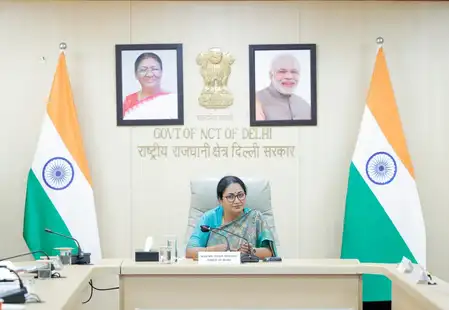
New Delhi, April 19 (IANS). Chief Minister Rekha Gupta has announced the formulation of a draft ‘Delhi Semiconductor Policy’, which aims to establish the capital as a major hub for semiconductor design, advanced research and development, and assembly and related activities.
Gupta said this initiative is a step towards promoting the high-value technology sector in Delhi.
The Chief Minister said that this policy is in line with Prime Minister Narendra Modi’s vision of ‘Self-reliant India’ and will ensure Delhi’s active participation in the development of India’s semiconductor sector.
Chief Minister Rekha Gupta said the semiconductor sector has emerged as an important pillar of the global economy, and the Delhi government is working on a comprehensive policy framework to ensure its balanced and orderly growth.
The policy envisages providing both financial and non-financial incentives to promote ease of doing business, innovation and industry-based ecosystem.
The proposed policy is based on five main pillars. These include semiconductor design and intellectual property development; Research, Development and Innovation; development of manufacturing-enabled activities such as assembly, testing, marking and packaging (ATMP) and outsourced semiconductor assembly and testing (OSAT), as well as supporting industries; talent development and skills development; And strengthening the startup and industrial ecosystem.
The Chief Minister said that this policy is expected to strengthen Delhi’s position in the high-value segment of the semiconductor value chain, especially in the areas of design, research and development, and advanced packaging. This is likely to attract investments from fabless semiconductor companies, startups, as well as ATMP and OSAT units.
This policy will also help in the development of supporting industries related to testing, packaging and semiconductor inputs.
Emphasizing on employment prospects, the Chief Minister said that this policy will create high-quality employment opportunities in areas like chip design, semiconductor research and advanced packaging. It also aims to promote skill development through targeted training programmes, internships and industry-academia partnerships.
This initiative is expected to help in attracting and retaining skilled professionals, thereby further strengthening Delhi’s position as a hub of knowledge and innovation.
The policy emphasizes targeted incentives to promote private investment, reduce operating costs and create a conducive business environment.
Measures such as capital subsidies, infrastructure development and synergy with national initiatives, especially ‘India Semiconductor Mission’ are expected to enhance investor confidence and encourage participation from both domestic and global players.
–IANS
SCH