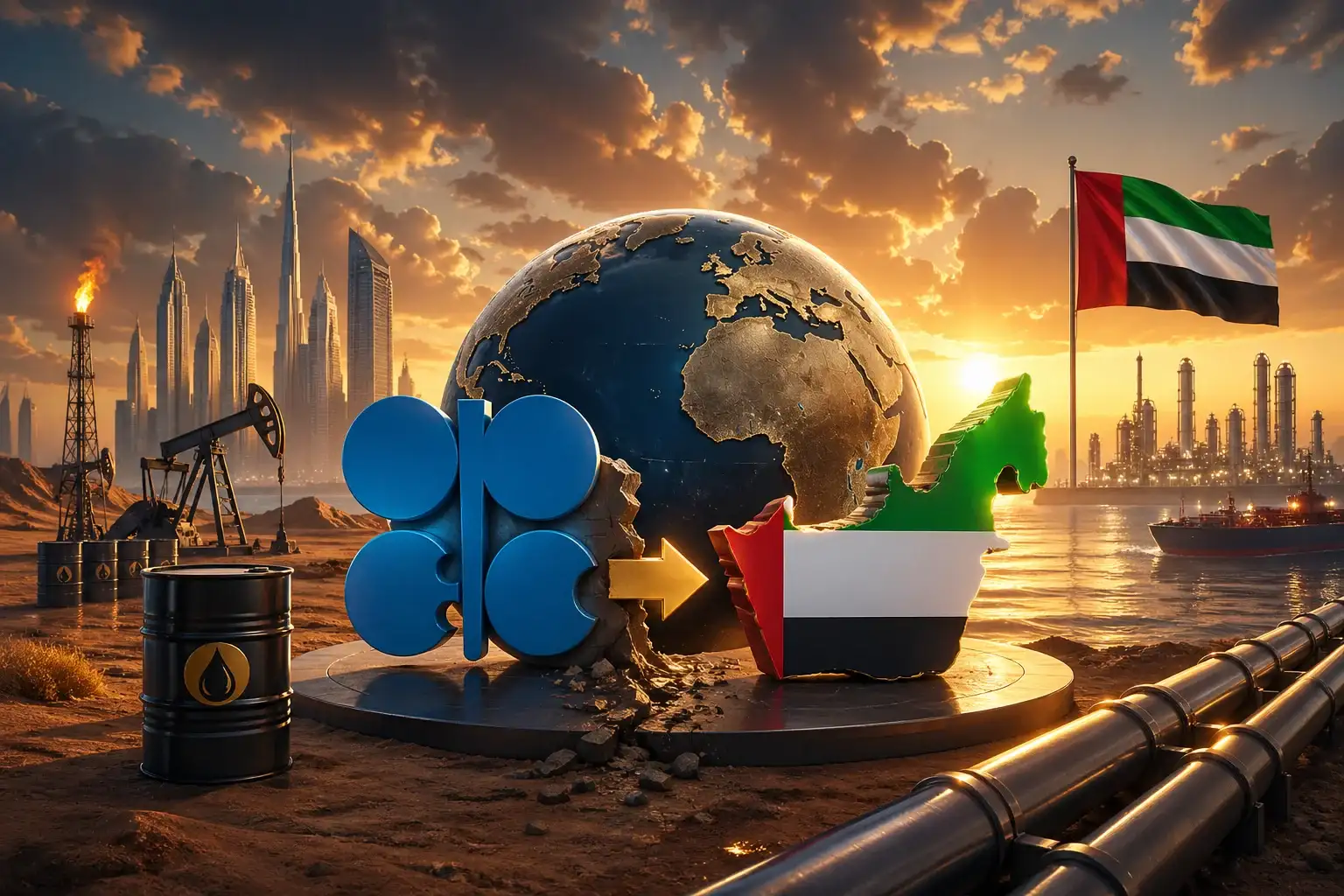
The crude oil market—which is like the blood flowing in the veins of economies around the world—is currently witnessing a movement that has surprised even the most experienced experts. The United Arab Emirates (UAE) has formally announced its separation from OPEC, the world’s most powerful oil organization. This news assumes great significance as the UAE has not only been a long-standing and trusted member of OPEC, but is also one of the world’s largest oil producers. At a time when energy prices are dictating the direction of global politics, the UAE’s decision is more than just a strategic shift; It is an open challenge to OPEC’s decades-long dominance.
What is OPEC, and how did it come to be?
OPEC—the “Organization of the Petroleum Exporting Countries”—is an international organization representing the world’s major oil-producing countries. It was established during the Baghdad Conference in September 1960. Initially, it consisted of five founding members: Iran, Iraq, Kuwait, Saudi Arabia, and Venezuela. At that time, the world’s oil resources were controlled by Western multinational corporations—collectively known as the “Seven Sisters”. These countries joined hands to end the dominance of these corporations and establish their sovereign rights over their natural resources. Today, its headquarters is located in Vienna, the capital of Austria, from where the direction of the global oil market is decided.
How does OPEC work?
The functioning of OPEC is completely based on mutual coordination of supply and demand. This organization works as a price regulator. Its member states gather periodically in Vienna to collectively set a daily amount of oil production—a figure known as a “production quota”. When oil prices start falling in the market, OPEC members cut production; This reduces the supply of oil in the market, causing prices to rise again. Conversely, when demand for oil is high, efforts are made to stabilize prices by increasing production.
The real reason for UAE’s separation from OPEC
There are many deep economic and strategic reasons behind the UAE’s disillusionment with this organization. Over the past few years, the UAE has invested billions of dollars to expand its oil production capacity. Its objective is to fully utilize this potential and sell more oil and by doing so strengthen its economy. However, the UAE faced restrictions due to OPEC’s strict production quota rules. As a result, OPEC’s terms of membership prevented it from extracting oil to its full capacity. The UAE now feels that considering its future plans and production capabilities, OPEC’s rules are proving to be detrimental to the country.
Conflict arising from Saudi Arabia’s dominance
Historically, Saudi Arabia has had the most influence within OPEC. Most major decisions within the organization are often taken as per the wishes of Saudi Arabia. In recent years, differences have emerged between the UAE and Saudi Arabia over energy and economic policies. UAE now wants to create a separate identity for itself and does not want its decisions related to production to be taken under the pressure of any organization. After Qatar’s separation from OPEC in 2019, this move by UAE raises many important questions regarding the unity and future of the organization. This clearly shows that oil producing countries are now giving more priority to their national interests rather than the collective interests of the organization.
Is OPEC’s strength weakening now?
OPEC—an organization that once controlled the world economy—now appears to be slowly losing its influence. Due to increased US shale gas production and the growing influence of countries like Russia, OPEC is increasingly relying on the “OPEC+” framework. The separation of an influential country like UAE from the organization is a huge psychological and economic blow to OPEC. This development is expected to weaken OPEC’s ability to control the global market. As the world is moving towards green energy, the growing rivalry among oil producing countries is signaling the beginning of a new era in the global energy landscape.