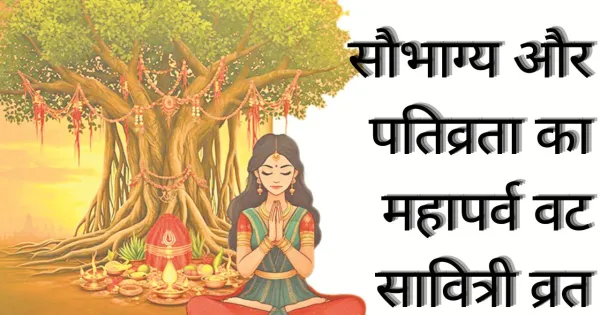
Amavasya of Krishna Paksha of Jyeshtha month is called Vat Savitri Amavasya. On this day, fortunate women observe Vat Savitri fast and worship the banyan tree and Yamdev to attain unbroken good fortune. In Indian culture, this fast has become a symbol and synonym of ideal womanhood. In Vat Savitri fast, both Vat and Savitri have special significance. This year this festival will be celebrated on Saturday 16th May.
Almost every Sanatan devotee is well aware of the mythological story of Savitri-Satyavan related to this fast, which is known as ‘Bargadahi’ in North India, which reflects the excellent eternal life values of Sanatan culture. That amazing development of the Vedic era still overwhelms both the readers and listeners. It is rare to find such a unique example in any other religion and culture. It is said that Mahasati Savitri had resurrected her dead husband from Yamraj, the god of death, under the banyan tree. Since then the banyan tree became revered as a god tree in Hindu religion.
If we think from a metaphysical point of view, in this Mahavrat of Vat Pujan, along with the great feeling of victory of the strong will of women power, the sacred message of importance of trees and environmental protection is also hidden in our lives. According to the story, Savitri was the daughter of King Ashwapati, whom the king obtained by the grace of Goddess Savitri after doing very difficult penance. That’s why the king named her ‘Savitri’. Savitri was very talented and beautiful, but Savitri’s father used to be sad due to not finding a suitable groom for her. Therefore, he sent his daughter to search for her husband and during this search, one day Savitri saw Satyavan in the forest and because of his qualities, she selected him as her husband. Satyavan was the son of King Dyumatsen of Salva country, but his kingdom was taken away by someone and due to the influence of time, Satyavan’s parents became blind.
Even before the marriage of Satyavan and Savitri, Narada Muni had told the truth to Savitri that Satyavan was short-lived, hence she should not marry him. Despite knowing this, Savitri decided to marry Satyavan and said to Devarshi Narad – Indian woman chooses her husband only once in her life, not again and again. Therefore, I have chosen Satyavan only once and if I have to fight even to death for him, I am ready to do it. As the time of her death approached, Savitri gave up food and water three days before her death. On the day of his death, when Satyavan went to the forest to cut wood, Savitri also went with him and when the time of death approached and Yamraj came to take away Satyavan’s life, Savitri also started accompanying him. Despite a lot of persuasion from Yamraj, she was not ready to return. Then Yamraj asked him to ask for any other boon except the life of Satyavan.
In that situation, Savitri asked for the eyesight of her blind mother-in-law and the lost kingdom of her father-in-law, but did not accept to return. Pleased with her steadfast devotion to her husband, when Yamraj again asked her for a boon, she asked for the wise boon of becoming the mother of Satyavan’s sons. As soon as Yamraj said ‘Amen’, Satyavan’s dead body lying under the banyan tree came alive after being freed from the noose of death. Since then, the tradition of observing this fast to attain unbroken good fortune started and in this fast it became a tradition to worship the banyan tree and Yamdev. Maharishi Shri Aurobindo has also composed the epic Savitri keeping this story at the center, in which he has woven the story of Savitri in the form of a journey of spiritual life and its experiences. It can also be called a spiritual book of Savitri Sadhana.
Many viewpoints of banyan tree: Banyan tree is important from many points of view, first of all this tree is famous for its hugeness. If seen from a philosophical point of view, this tree is a symbol of longevity, because under this tree Prince Siddhartha attained enlightenment and was called Lord Buddha. Due to attaining enlightenment, this eternal banyan tree is also called Bodhi tree, which is situated in Gaya Tirtha. Similarly, in Varanasi also there are such banyan trees, which are worshiped as Akshayvat. Banyan tree provides coolness and purity to the environment and is also very beneficial from spiritual point of view.
banyan tree
According to the scriptures, like the Peepal tree, the Banyan tree also has special importance. According to the Puranas, Brahma is believed to reside in the root of the banyan tree, Vishnu in the middle and Shiva in the front. Hence, it is believed that by sitting under it and worshiping and listening to fasts etc., wishes are fulfilled. This tree remains renewable for a long time, hence it is also called Akshayavat. Jains and Buddhists also consider Akshayavat to be extremely sacred. Jains believe that their Tirthankar Lord Rishabdev had performed penance sitting under Akshayavat. This place in Prayag is known as Rishabhdev Tapasthali or Tapovan. In our forest culture, trees have been considered living gods.
Vat Savitri Vrat, a great festival of good fortune and devotion to husband
Vedic Manisha says that the dense shady trees swaying with the gusts of wind and the creepers embracing them are not only the adornment of nature but also the eternal source of life. The entire civilization, culture, religion and spiritual philosophy of our country was developed in the forests only. In Vedic India, people used to worship Vanadevi regularly. In Smriti texts, strict punishment has been prescribed for those who destroy forest wealth.
Let it be known that along with giving us greenery and fruits and flowers, trees and plants also give us the blessing of life and good health with their vital air. Not only do they have an invaluable contribution in environmental protection, but they also remove planetary and Vaastu defects. The health of our entire environment depends on the grace of these silent gods. That is why deep reverence and affection towards trees and plants has been a very ancient and sensitive tradition of Indian culture. Therefore, this ritual of worshiping the banyan tree in the form of Vat Savitri Vrat is a symbol of the pride and dignity of Indian culture and through this one also gets to know the medicinal importance of trees and their divine form.