: Thursday, February 19, 2026 12:40 PM
– Dr. Priyanka Saurabh –
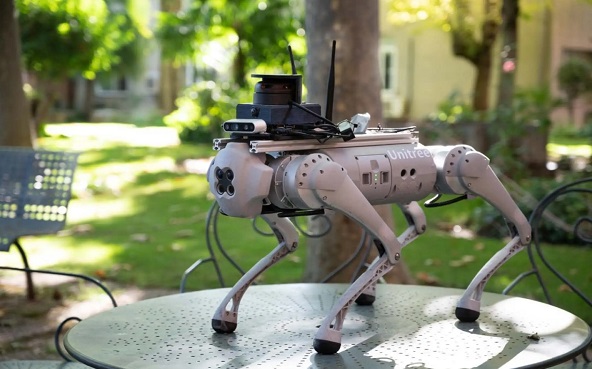
The recent controversy surrounding the demonstration of robodogs at Galgotias University became the subject of widespread discussion on social media and mainstream media. On the surface this issue may appear to be a matter of appropriateness, priorities or campus culture, but in reality it is merely a symptom of a deeper and structural crisis that has been brewing in India’s higher education system for years. The problem isn’t the robodog. The problem is what our universities have gradually become. There has been unprecedented expansion of higher education in India in the last two decades. The number of private universities, self-financed colleges and degree institutions has increased rapidly. This expansion was often presented as “increased access to education” and “demographic benefits.” But when this expansion occurred without parallel regulation, academic rigor and accountability, it came at a cost to quality. The result was that the quantity increased, but the quality continued to decline. Today most—though not all—private universities and degree colleges in the country have become less centers of education and more centers of degree distribution.
Education is becoming not an intellectual process but a transaction—a degree in exchange for money. Things like attendance, academic participation, laboratory work and intellectual discipline are no longer mandatory but have come under the ambit of compromise. What was once uncompromising in higher education has now become flexible, weak and distorted. This decline is particularly worrying in subjects where rigor is mandatory. The weakening of theoretical education is one thing, but the hollowing out of science education is much more serious.
Today the situation is such that students are obtaining bachelor’s and master’s degrees in subjects like science without attending regular classes and without taking practical training in the laboratory. Experimental work—once the backbone of scientific training—has now become a formality. Degrees are being given, but efficiency is not being ensured. The consequences of this hollowness are evident when students appear for jobs. A master’s student in chemistry is unable to explain basic scientific concepts. A commerce graduate is not able to explain the basic concept of debit and credit.
A student holding a management degree appears to be weak in problem-solving and critical thinking. These are not isolated examples, but are general trends being observed time and again by the industry. Naturally this creates frustration among students and parents. When employment is not available despite years of study and huge financial investment, questions arise. Parents are absolutely right to ask why the child is unemployed even after studying.
Often the target of this dissatisfaction is the government, which is accused of not being able to create employment. While job creation is a policy challenge, this discourse ignores an uncomfortable truth—that a large number of graduates are actually not employable. This is where the basic question arises. If students do not have the required knowledge and skills, how did they get the degrees that declared them worthy? Who allowed such institutions to distribute certificates without ensuring academic quality? We find the answer to this in the regulatory framework of higher education.
Higher education in India is overseen by a number of ministries, departments and regulatory bodies whose stated objectives are to protect standards, ensure quality and maintain academic integrity. Accreditation systems, inspection, assessment and academic audit were created for this very purpose. But in practice these processes have often become formal rituals rather than actual evaluation. Inspections are often pre-scheduled. Documents are decorated to complete the formalities.
Buildings and infrastructure are given priority over teaching quality. Compliance is placed above learning outcomes. The actual academic experience of students, the quality of teaching, the rigor of testing, and the culture of curiosity—these are rarely monitored seriously and consistently. As a result, institutions learn to “manage” regulators rather than improve education. This regulatory laxity has given rise to a vicious cycle—institutions continue to operate with minimal academic accountability, maintain the appearance of regulatory oversight, and degrees continue to be issued.
The cost of this system is paid neither by institutions nor by regulators—but by students, employers, and society. The irony is that on one hand the industry complains of shortage of qualified human resources, while on the other hand the country is facing a serious crisis of educated unemployment. This is not a contradiction, but a natural consequence of a system where certification is placed above ability. Companies are forced to spend heavily on retraining new employees, while young professionals struggle with lack of confidence and career stagnation.
The biggest victims of this system are the honest and talented students, who often take admission in mediocre institutions due to lack of options or misleading branding. They work hard, want to learn, but ultimately they have to bear the burden of the name of the institution on their mark sheet more than their ability. His individual competence is overshadowed by the lack of institutional credibility. This is not only injustice but also a waste of talent at the national level.
It has to be acknowledged that India still has some high-quality institutions that compete at the international level. But they are the exception, not the rule. It is noteworthy that school education till class 12th is still relatively more structured and controlled. As students enter higher education, oversight loosens and expectations become blurred. If this trend is not stopped in time, its long-term consequences will be serious.
The social and economic value of degrees will decline. Public confidence in higher education will weaken. The distinction between competence and mediocrity will become more blurred. Sentences like “university in every street” will not become satire, but a description of reality – where universities will be everywhere, but education will not. Now is the time for reform—and that reform must be honest and rigorous. Regulatory bodies need to go beyond box-ticking and adopt outcome-based, transparent and unpredictable evaluation.
The quality of teaching, learning outcomes, student participation and integrity of assessment have to be put above buildings and advertisements. Accountability of institutions will have to be fixed. Concrete action should be taken against colleges and universities that are consistently failing academically—ranging from reduction in seats, suspension of courses or de-recognition. Higher education cannot be a business where there is no cost for failure. Students and parents will also have to be more alert. Making decisions based solely on marketing, infrastructure and branding is a compromise with the future.
Education is not a simple purchase, but an investment in intellectual and professional development—and the wrong decisions have far-reaching consequences. Ultimately, the purpose of higher education is not to distribute degrees but to produce thoughtful, capable, and responsible citizens. Until this core objective is reestablished, controversies like RoboDog will continue to arise—make noise for a while and then subside—while the real crisis will remain as it is. We do not need decorative reforms, but systemic introspection. Because the crisis of education is never limited to just the classroom—it silently shapes the future of the nation.
(Writer, PhD (Political Science), poet and social thinker.)
Read this also – Click to read the news of your state/city before the newspaper.