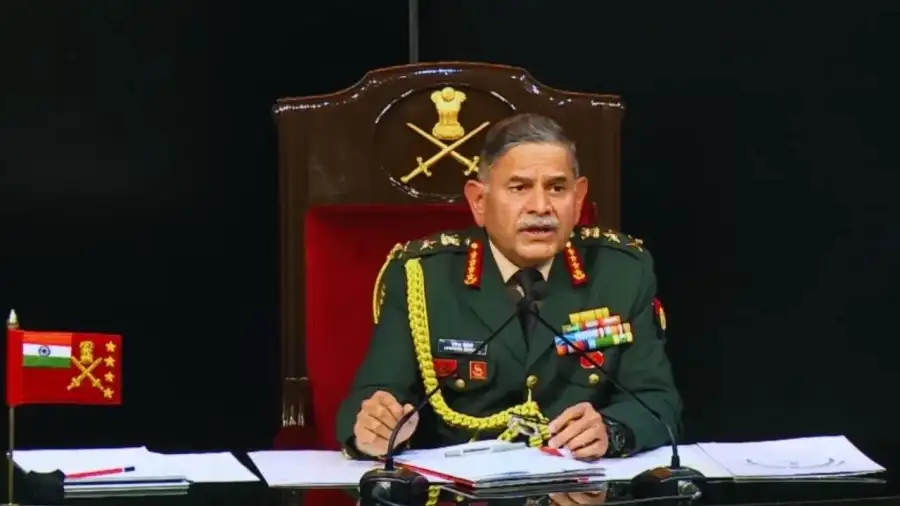
India has once again given a clear message to China and Pakistan regarding Shaksgam Valley. Army Chief General Upendra Dwivedi reiterated that the border agreement signed between Pakistan and China in 1963 is completely illegal and invalid for India. He said that Shaksgam Valley is part of India and India does not recognize any activity there. The Ministry of External Affairs had also earlier clarified on this issue that India reserves the right to take all necessary steps to protect its interests.
India does not accept the 1963 agreement
The Army chief said in a press conference that Pakistan had handed over a part of the Shaksgam Valley to China under a 1963 agreement, which India has never accepted. He said clearly, “We do not accept any activity there. This agreement is illegal for us.” General Dwivedi said that China-Pakistan Economic Corridor (CPEC) is also not acceptable for India. He called it an illegal act being done by both the countries and said that this project passes through Indian territory.
Army’s stance on women’s entry
The Army Chief said that in future women can also join Infantry and Para-SF, but the society needs to be prepared for this. He clarified that the Army talks about gender neutrality, not gender equality. If women meet the standards set by the Army and meet the medical fitness requirements, doors are open for them. General Dwivedi said that the Army expects an increase in the defense budget in the coming times, which will further strengthen its capabilities.
Strength increased from 13 Bhairav battalion
He told that till now 13 Bhairav Light Commando battalions have been formed in the Indian Army. These units will bridge the gap between the lethal infantry platoons and Para-SF and meet the needs of modern warfare.
New reality of drone war
The Army Chief said that it is difficult to estimate the number of drones today. There could be thousands of drones at a range of 500 kilometers. He said that the Indian Army has also tested drones with a range of 100 kilometers and the capability to make drones is being developed in every command.
Strategy changed after Operation Sindoor
General Dwivedi said that after Operation Sindoor, the role of drones has become stronger. Under this, ‘Ashani Platoons’ have been formed in the infantry battalions, in which specially trained drone operators are deployed.
Bhairav Battalion and Divyastra Battery
He informed that Bhairav battalion has been equipped with UAS and counter-UAS systems, heavy ammunition and modern resources. Apart from this, a ‘Divyastra Battery’ has been created in the Artillery, which will provide direct support to the Division Commander.
India keeps a close eye on Bangladesh
General Dwivedi said that Bangladesh currently has an interim government, so India does not need to react immediately. He said the three armies are in constant touch with the Bangladesh Army and there is no activity against India.
Presence and deployment of terrorists strengthened in Jammu
The Army chief said about 40 terrorists, mostly Pakistanis, are present in the Jammu region, south of Pir Panjal. He said that there will be no reduction in military deployment in this area.
Ceasefire violations and Operation Sindoor
He said there have been 139 ceasefire violations so far in 2025, of which 124 occurred during Operation Sindoor. In Operation Sindoor, 7 out of 9 targets were destroyed, and the operation is still ongoing.
Situation on the northern and north-eastern borders
The Army Chief said that the situation on the northern border is stable, but vigilance is necessary. Indian deployment along the LAC remains balanced and strong. The situation in Manipur in the northeast has improved during 2025, and cooperation will further improve after the Myanmar elections.
Operation Sindoor is still going on
Finally, General Upendra Dwivedi clearly said that Operation Sindoor is not over yet. Any wrongdoing in future will be responded to with full force. He appreciated the role of CAPF, intelligence agencies, state administration and all ministries.