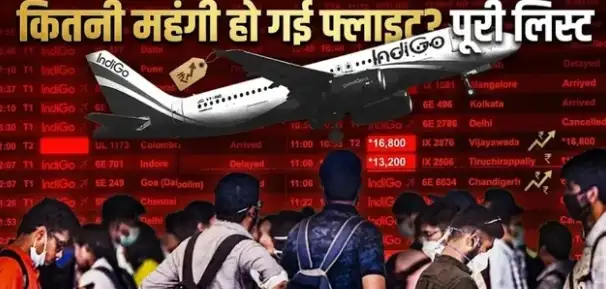
Flights of the country’s largest airline, IndiGo, are going to become more expensive from Thursday. The airline has imposed an additional fuel surcharge of up to ₹950 on domestic flights and up to ₹10,000 on international flights. The new rates will be applicable from 12:01 am on April 2. This is the second time in just 18 days that IndiGo has decided to increase fuel surcharge on both domestic and international routes. Earlier, the company had also increased the fare on March 14. According to the company, the decision was taken due to the steep rise in prices of aviation turbine fuel (ATF)—also known as jet fuel. Data from the International Air Transport Association (IATA) shows that fuel prices have increased by more than 130% in the last one month alone.
Fees will be decided based on distance
The Civil Aviation Ministry has barred airlines from passing the entire financial burden directly on to customers. At present, the government has allowed only a 25% increase in domestic flight fares. According to IndiGo, it has “recalibrated” its fuel surcharge based on distance; This means that the longer your journey, the higher the fuel surcharge you will have to pay on your ticket.
Approval of additional duty of ₹ 50/liter on fuel
Increase in taxes is another major reason for increasing operating costs. On Wednesday, Rajya Sabha passed a proposal to impose additional excise duty on Aviation Turbine Fuel (ATF). Under this proposal, a notification issued on March 26, 2026 has been approved. As a result, the Finance Act, 2002 will be amended to impose additional excise duty of ₹50 per liter on ATF.
Jet fuel: airlines’ biggest single expense
Due to the steep rise in jet fuel prices, airlines around the world have not only increased ticket fares, but also changed—or withdrawn—their future financial plans and projections. For airlines, jet fuel is their largest operating expense. This accounts for 30% to 40% of total operating expenses. This sudden change in oil prices has spoiled the budget of the airlines. Major airlines like Air New Zealand and Qantas have also made it clear that they will pass on these increased costs to passengers.
Airlines around the world that have increased fares
**Air New Zealand:** On Tuesday, Air New Zealand announced a huge increase in its ticket prices. The company has increased the one-way fare for domestic flights by NZ$10. Additionally, fares have been increased by $20 for short-haul international flights and $90 for long-haul flights. The company has also withdrawn its earnings forecast for 2026 due to extreme market volatility. **Hong Kong Airlines:** Starting Thursday, Hong Kong Airlines is increasing its fuel surcharge by 35.2%. For destinations like Maldives, Bangladesh and Nepal, this surcharge has been increased from 284 Hong Kong dollars to 384 Hong Kong dollars. Meanwhile, Cathay Pacific launched additional flights to London and Zurich in March to give passengers on the affected routes alternative options. The company is currently reviewing its fuel surcharge on a monthly basis.
**Qantas and SAS:** Australia’s national carrier, Qantas Airways, has increased fares on its international routes. However, the company says flights to Europe are operating at more than 90% capacity; As a result, they are looking to increase capacity in the coming months. SAS (Scandinavian Airlines)—the leading airline in the Nordic region (Northern Europe)—has also implemented temporary price adjustments in response to rising costs.