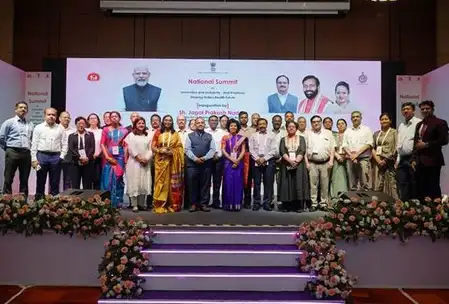
New Delhi, May 1 (IANS). The two-day national summit on “Innovation and Inclusivity: Best Practices Shaping India’s Health Future” concluded on Friday with technical deliberations and review of the findings. The report of the 17th Common Review Mission (CRM) was discussed in detail on the second and final day of the conference. This mission is considered an important mechanism for independent and evidence-based evaluation of health services under the National Health Mission (NHM).
On the first day of the conference, various states and union territories presented the best practices and innovations implemented in their respective sectors. These presentations included topics such as strengthening primary health services, use of digital health technologies, improving maternal and child health and better management of non-communicable diseases. These sessions provided a useful platform for mutual learning and sharing of experiences among the States.
Along with this, detailed presentations were also given on new and ongoing health initiatives from the Ministry. Their objective was to help states and union territories better align with national health priorities and effectively implement schemes at the grassroots level.
The findings received from 17 states and union territories during the CRM were discussed in depth in the technical sessions held on the second day on Friday. These findings revealed important information related to the availability of health services, the status of service delivery and the functioning of the governance system. The report also noted positive progress in several areas, including operationalization of Ayushman Arogya Mandirs, expansion of primary health services and increased adoption of digital health services.
Significant progress was also recorded in improving maternal and child health services, identification and treatment of non-communicable diseases and use of tele-consultation services. However, the discussions also identified areas such as better utilization of human resources, availability of essential medicines and equipment, and access to health services to remote areas, where further improvement is needed.
In the meeting, special emphasis was laid on improving the quality of data and strengthening real-time monitoring through digital platforms. There were also discussions on improving the referral system, increasing community participation and training of frontline health workers. Officials said these efforts will improve both the quality and accessibility of health services.
In the concluding session, Additional Secretary and Mission Director (NHM) Aradhana Patnaik appreciated the progress of the States and Union Territories. He said that now the focus will have to move beyond short-term goals to medium and long-term health goals. He also said that all plans should be aligned with the Sustainable Development Goals by 2030.
He also stressed on the expansion of digital health services and said that it should be ensured that no beneficiary, especially the weaker sections, faces any kind of problem. This requires continuously strengthening the training and capacity development of health workers. Apart from this, he also described biomedical waste management as an important challenge and stressed the need for improvement in this direction.
At the end of the program he appreciated the work of the CRM teams and said that their efforts have significantly helped in the improvement of the health system. The conference concluded with the message that the process of collaboration, innovation and experience sharing among the states will be continuously strengthened further, so that the health system of the country can become more strong and effective.
–IANS
SHK/VC