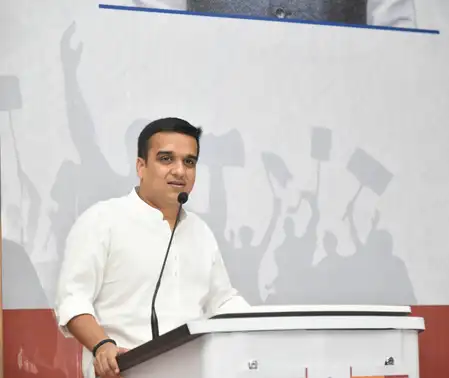
Gandhinagar, June 19 (IANS). Gujarat Deputy Chief Minister Harsh Sanghvi said on Friday that in the last 12 years, more than 4 crore pucca houses have been built across the country under the Pradhan Mantri Awas Yojana. Earlier, lakhs of poor families living in huts and temporary houses have got the opportunity to live a respectable life.
The Deputy Chief Minister was addressing the ‘NaMo Yuva Samvad: Developed India Blueprint’ program organized at the National Forensic Sciences University (NFSU), Gandhinagar.
He said that after 2014, the country has made significant progress in areas like agriculture, economy, transport, law and order and youth and women empowerment and citizens across the country have benefited from this.
This program was organized with the objective of motivating the youth for active participation in the goal of a developed India and connecting their ideas with the development agenda of the country.
While interacting with the students and youth, the Deputy Chief Minister discussed the objectives of “Developed India 2047”.
He said that before 2014, a large number of poor people were forced to live in temporary houses, but the construction of more than 4 crore permanent houses under the Pradhan Mantri Awas Yojana has brought about a change in the living conditions of a large section of the society.
He said that earlier more than half of the poor and middle class families of the country were outside the banking system, whereas now they have bank accounts and are connected to financial services.
“These figures are not just government schemes, but reflect the country’s strong commitment towards improving the living standards of the poor,” he said.
Harsh Sanghvi said that he has not come to the program to give a speech, but to listen to the thoughts and experiences of the youth.
He said the developments since 2014 have impacted many sectors and contributed to improving the lives of people.
Referring to infrastructure development, he said projects like Delhi-Mumbai Expressway and Atal Tunnel have significantly reduced travel time and fuel consumption.
He said that by the year 2026, two and a half times more airports will have been developed in India than the airports built from independence to 2014.
Referring to the UDAN scheme, he said that now common citizens and senior citizens are also able to travel by air at affordable rates.
Speaking on rail connectivity, he said that Vande Bharat Express and the proposed Bullet Train will not only save time but will also have a positive impact on the social life of millions of people who travel regularly for employment.
Referring to the Swachh Bharat Abhiyan, he said that the increasing awareness of cleanliness among children is laying a strong foundation for the Swachh Bharat of the future.
He appealed to the youth not to litter in public places and behave responsibly.
Referring to GIFT City, the Deputy Chief Minister said that the project which was once called a ‘daydream’ by critics, has today become a global financial centre.
He advised young entrepreneurs to focus on long-term and sustainable business models rather than short-term profits.
Speaking on the role of social media, he appealed to the youth to avoid unconfirmed rumors and misinformation and rely on factual information.
He said, “‘Developed India 2047’ is a resolution for the collective development of about 140 crore people of the country.”
Inspiring the youth, he said that when they face disappointment or frustration in life, they should take inspiration from the struggle and determination of Prime Minister Narendra Modi.
He said, “Whenever you feel disappointed, read about the life and books of Prime Minister Narendra Modi and find the way to move forward through hard work.”
This program was also organized to commemorate the completion of 12 years of Prime Minister Modi’s rule.
During the programme, the Deputy Chief Minister also released the book ‘Narendra Modi Ek Sarjak’ written by Gujarat Sahitya Academy President Bhagyesh Jha.
–IANS
AMT/DKP