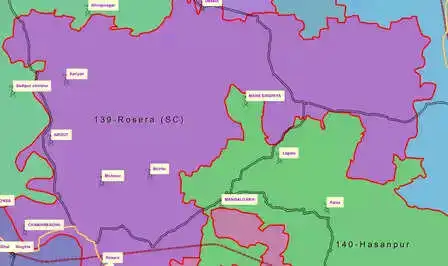
Patna, 4 October (IANS). Rosda assembly constituency (SC-safe) of Samastipur district holds an important place in Bihar politics. This seat is known not only for election results, but for its deep political history and changing social equations. For decades, this seat has been a stronghold of Left (CPM) ideology, but the Bharatiya Janata Party (BJP) has strengthened its penetration in the last decade.
The 2020 assembly election proved to be the decisive turn of the political direction here, when the BJP candidate registered a historic victory.
The Rosda assembly election was witnessed in 2020 unilateral contest. Bharatiya Janata Party (BJP) candidate Virendra Paswan, who is contesting elections under the National Democratic Alliance (NDA), defeated Congress candidate Nagendra Kumar Paswan Vikal by a margin of 35,744 votes.
This huge difference of 35,744 votes reflects BJP’s strength in Rosda’s electoral politics. Virendra Paswan not only won, but also proved with 47.93 percent vote share that a large part of voters on this safe seat was firmly united in his support.
The Congress was reduced to only 28.27 percent of the votes, despite being part of the Grand Alliance, while Krishna Raj of LJP also made the match more complicated by cutting 22,995 votes (12.64 percent).
Rosda’s electoral history has been very interesting and ups and downs. Since 1977, both the BJP and the Communist Party of India (Marxist) have won this seat four times, which reflects the ideological polarization of the people here. This figure suggests that Rosda was once painted in the redness of the Left, but is now completely under the influence of right -wing ideology.
In 2020, BJP candidate Virendra Paswan won from here. Earlier in 2015, Congress candidate Dr. Ashok Kumar won this seat. In 2010, BJP candidate Manju Hazari won this seat.
If we look at the results of 2015, Dr. Ashok Kumar of Congress won by a margin of 34,361 votes by getting 85,506 votes. The win was the opposite of the 2020 result, showing that the voter of Rosda is not permanently loyal to any one party, rather it decisively changes its decision based on the coalition air and the local appeal of the candidate.
Earlier in 2010, BJP’s Manju Hazari won by a close margin of 12,119 votes, which was an early sign of BJP’s rise in the region.
Rosda is a reserved seat for a scheduled caste, which means that the politics of communities such as Dalit communities, especially Paswan and Ravidas (ie Ravidas) play a decisive role. The two prominent candidates in 2020 clearly underline the political significance of this community, the Paswan community.
This seat is focused on issues of Dalit Asmita, Reservation and local development. In the politics here, the traditional Dalit-emergent basis of the Grand Alliance (RJD-Congress) is, which the BJP has made inroads on this seat through welfare schemes of the Central and State Government.
Rosda assembly constituency works as a bridge between leftist history and current saffron influence. This seat is a political arena where the Left has lost its roots and the BJP has firmly caught them.
The return to Rosda in this election will be a big challenge for the Congress and RJD’s grand alliance. They will not only have to break the strong hold of the BJP, but also to stop the scattering of Dalit votes. The future of Rosda’s politics will depend on whether the Grand Alliance is able to re -establish its credibility among the Dalit voters or the BJP’s leadership as Virendra Paswan maintains its rapid victory.
-IANS
VKU/VC