The political influence of Prime Minister Narendra Modi and Chief Minister Nitish Kumar was clearly visible in the Bihar Assembly elections. The NDA alliance is moving towards a one-sided lead. According to experts, the combined impact of the welfare schemes of the state and the Center has been significant, but even more effective was the narrative of “Jungle Raj” repeated repeatedly in Prime Minister Modi’s rallies, which was presented strongly in the context of the RJD regime.
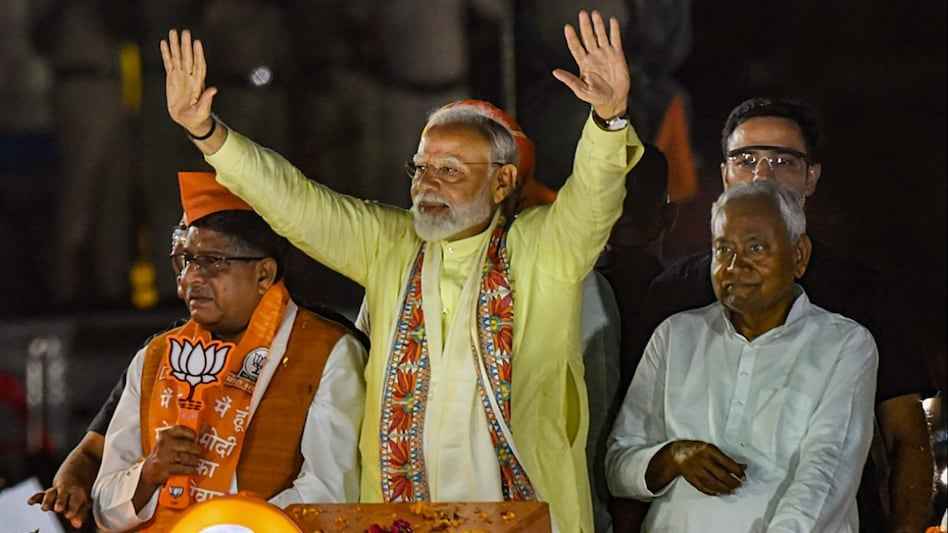
The Prime Minister addressed 13 rallies in Bihar and held a major road show in Patna. At these events, he mentioned Bihari pride, local traditions—especially Chhath Puja—and accused the RJD-Congress alliance of being “soft towards infiltrators” and “profiteering from public money while in power.”
During the election campaign, Prime Minister Modi kept communicating with NDA constituents regularly. By removing the controversies that arose after the selection of candidates, he gave the message of unity of the alliance.
A key element of Modi’s rallies was reminding of the RJD rule led by Lalu Prasad and Rabri Devi. He especially tried to convince the young voters that before falling prey to the promises of Tejashwi Yadav, they should learn about the “Jungle Raj era” from the elders of their families. Modi said that the young generation has seen only Nitish Kumar as the Chief Minister for a long time, so it is important to understand the circumstances of the past.
The Chhath festival—which was celebrated across the state just before the first phase of elections (November 6)—also became a major cultural symbol of the BJP’s campaign. At a rally, Prime Minister Modi hit out at Congress leader Rahul Gandhi, saying “Congress’s namdars call devotion to Chhathi Maiya a ‘drama’,” and alleged that this reflected their mentality towards Dalits and backward classes.
The Prime Minister began the election campaign on October 24 from Samastipur, the birthplace of socialist leader Karpoori Thakur, who was recently awarded the Bharat Ratna by the NDA government.
After this, on October 30, he held public meetings in Muzaffarpur and Chhapra. His rallies were held in Katihar and Saharsa on 3 November, Bhagalpur and Araria on 6 November, Bhabua and Aurangabad on 7 November, and Bettiah and Sitamarhi on 8 November.
Along with this, the Prime Minister interacted with the workers through the program ‘Mera Booth Sabse Strong’ and asked them to ensure that information about the schemes of the Center and the State reaches every citizen of the state.
Bihar has largely supported Modi in the last several elections—the 2014, 2019 and 2024 Lok Sabha elections, and the 2020 and 2025 assembly elections. This time also the same political trend is visible.