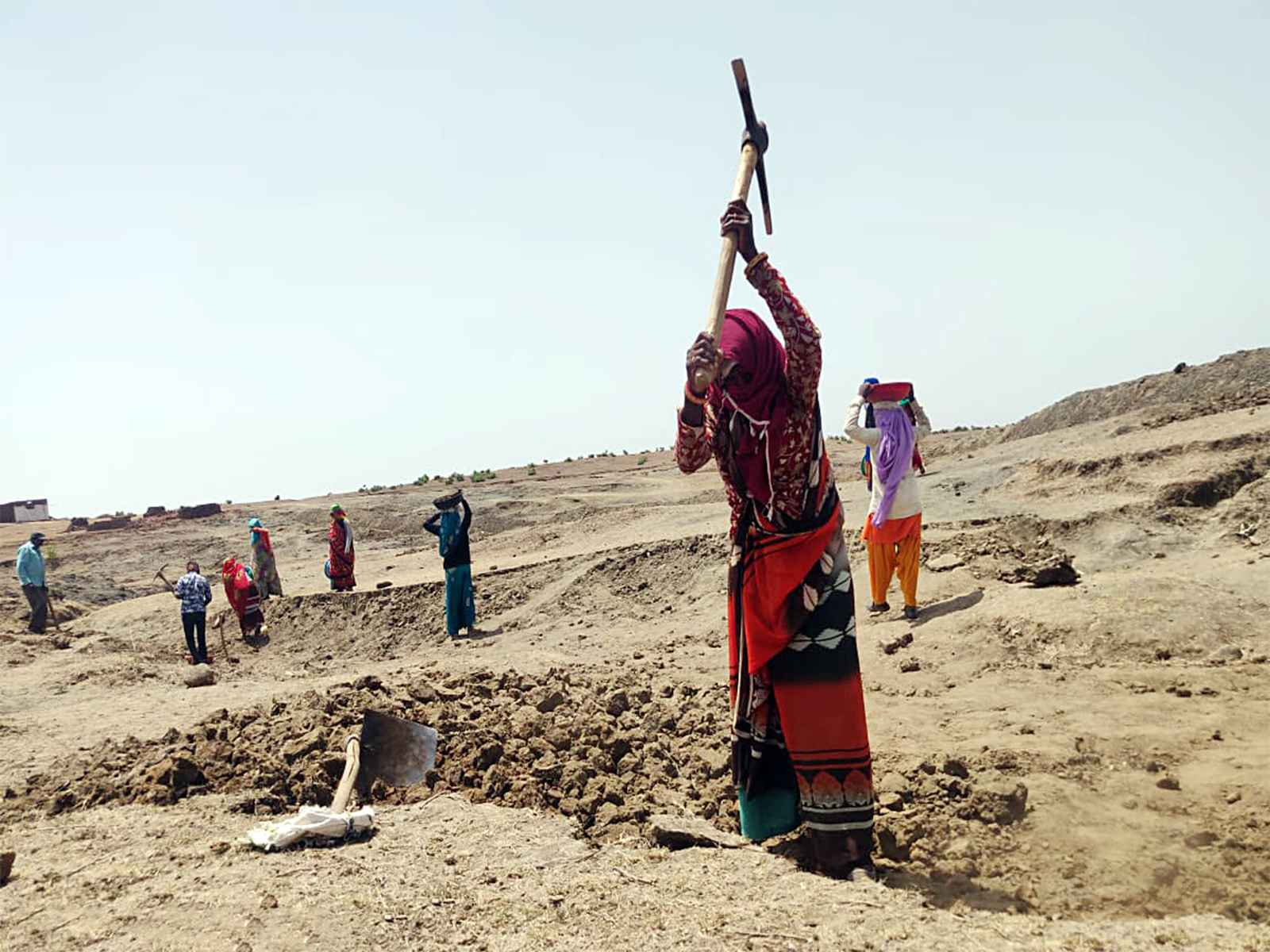
In a major overhaul of India’s rural employment framework, the Central Government has introduced the Guarantee for India-Employment and Livelihoods Mission (Rural), VB-G Ram Ji Act, 2025, which replaces the two-decade old Mahatma Gandhi National Rural Employment Guarantee Act (MNREGA) with a modern, infrastructure-centric and digitally driven statutory system, in line with the vision of India 2047.
Under the new Act, every member of a rural household is assured 125 days of salaried employment instead of the current 100 days. This employment is for those adult members who are willing to do unskilled manual labour.
It aims to create sustainable and productivity enhancing rural assets while providing income security through a nationally coordinated development strategy.
Under this legislation, all actions will be organized into four priority areas – water security through water-related actions, core rural infrastructure, livelihood-related infrastructure and specific actions to mitigate the impact of extreme weather events.
The assets created under this program will be aggregated into the evolving India National Rural Infrastructure Stack, enabling integrated planning, monitoring and integration with national spatial platforms such as PM CATI-Shakti.
Officials said the new framework addresses long-standing structural weaknesses in MGNREGA, while also strengthening transparency, accountability and outcomes.
Unlike the previous system, where work was spread across multiple categories without a coherent national strategy, the VB-G Ram Ji Act focuses on building targeted infrastructure that directly supports agriculture, livelihoods and resilience to climate change.
The Act also mandates developed Gram Panchayat plans, designed at the local level, but integrated with national spatial and digital systems to ensure better planning and implementation.
The government said the Act would have a cascading effect on the rural economy. Prioritizing water-related works is expected to strengthen irrigation and groundwater recharge, building on initiatives like Mission Amrit Sarovar, under which more than 68,000 water bodies have already been created or rejuvenated.
Basic infrastructure in rural areas, such as roads and connectivity, is intended to improve market access, while livelihood infrastructure, such as storage facilities and local markets, is expected to diversify incomes. Protecting assets from climate change, including flood evacuation and soil conservation works, aims to protect rural livelihoods from extreme weather events.
With the guarantee of 125 working days, the income and consumption of rural households is expected to increase, thereby stimulating economic activity at the village level and reducing migration due to the crisis. Digital attendance systems, electronic salary payments and data-based planning are expected to further improve efficiency and formalization.
Farmers are also expected to get direct benefits. The Act allows states to suspend public works for a total of 60 days during peak sowing and harvesting periods, which will ensure adequate labor availability for agriculture and prevent artificial wage inflation.
Officials said the provision would help stabilize food production costs and encourage workers to turn to higher-paying seasonal agricultural work. Improved water, irrigation, storage and connectivity facilities are expected to further boost agricultural productivity and market access.
The government said that for workers, the new Act strengthens both income security and worker protection. An increase of 125 guaranteed days would increase potential earnings by 25 percent. Hyper-local planning through Gram Panchayat schemes is expected to ensure regular availability of work.
Also, biometric and Aadhaar-based verification will continue to be the basis for electronic salary payments, which was almost 100 per cent in 2024-25. Under prior law, states were mandated to pay unemployment benefits when employment was unavailable.
The government explained the rationale behind changing MNREGA, saying that significant structural changes have taken place in rural India since 2005. Poverty levels have declined sharply – from 25.7 per cent in 2011-12 to 4.86 per cent in 2023-24 – supported by rising consumption, better financial access and diversification of livelihoods, as reflected in the MPCE and NABARD surveys.
In this context, the open and demand-driven model of MGNREGA was becoming increasingly inconsistent with current realities.
A standard financing model has been adopted under the new Act, bringing rural employment in line with the budget framework used for most central schemes. Officials clarified that this does not weaken the legal guarantee of employment.
The accuracy of forecasting in 2024-25, mandatory unemployment allowance, Centre-State shared responsibility and special exemptions during disasters aim to ensure that the 125-day guarantee remains fully protected.
The government acknowledged that several reforms have been made under MNREGA over the years, including greater participation of women, almost universal electronic payments, Aadhaar seeding, geo-tagging of properties and increased creation of individual properties.
However, investigation and monitoring reports continue to reveal serious issues, including non-performance, misappropriation of funds, use of machines in labour-intensive projects, bypassing of digital attendance systems and large-scale embezzlement of funds.
In 2024-25 alone, embezzlement in states amounted to Rs 193.67 crore, while only a few households completed 100 days of work in the post-pandemic period.
Citing these persistent challenges, officials said the gravity of the problem requires a new legislative framework rather than incremental reforms.
The VB-G Ram Ji Act includes AI-based fraud detection, real-time dashboards, GPS and mobile-based monitoring, weekly public disclosures, social audit twice a year for each gram panchayat and better monitoring through central and state steering committees.
The Act converts the program from a Central Sector Scheme to a Centrally Sponsored Scheme, with the standard Centre-State funding ratio of 60:40, 90:10 ratio for North-Eastern and Himalayan States and full central funding for Union Territories without legislature.
Officials said the change recognizes that rural employment is inherently local, while also ensuring that national standards are maintained.
Predictable standard allocations are expected to support the state budget, while strong monitoring aims to minimize long-term damage caused by misuse of funds.
The government said the restructured framework balances the interests of farmers, laborers and states, and positions rural employment as a driver of sustainable infrastructure, climate change resilience and inclusive growth towards a developed India 2047.