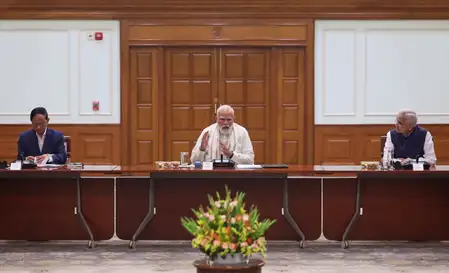
New Delhi, June 6 (IANS). Prime Minister Narendra Modi on Saturday chaired the meeting of the Economic Advisory Council to the Prime Minister (EAC-PM). According to officials, the meeting discussed measures to maintain the country’s economic growth momentum, further strengthen the economy and deal with emerging global challenges amid the West Asia crisis.
The meeting discussed strategies to further accelerate economic growth at a time when many of the world’s major economies are facing challenges such as geopolitical uncertainties, supply chain disruptions and weak demand.
According to officials, Prime Minister Modi and members of the Economic Advisory Council shared their views on the policy steps needed to sustain India’s growth rate and ensure macroeconomic stability amid difficult global conditions.
Reforms related to making people’s lives easier and increasing ease of doing business were also discussed in the meeting. The focus of the discussions was to make governance more effective, reduce compliance burden and create a better environment for investment and entrepreneurship.
An important part of the meeting was about the effects of the ongoing conflict in West Asia. Council members discussed its possible impact on India and the global economy.
Concerns over energy markets, trade routes and macroeconomic stability were reviewed during the discussions, as prolonged tensions in the region are adding to uncertainty in global markets.
This important meeting comes at a time when India continues to be among the fastest growing major economies of the world despite rising global uncertainties and geopolitical tensions.
India’s GDP growth rate in the January-March quarter (Q4) of financial year 2025-26 is estimated to be a strong 7.8 percent, while the economic growth rate for the entire financial year stood at 7.7 percent. This performance was mainly due to strong growth of the agriculture, manufacturing and services sectors.
India imports a large part of its energy needs. In such a situation, the government is constantly keeping an eye on the situation in West Asia, because prolonged instability can affect crude oil prices and international trade flows.
The Prime Minister’s Economic Advisory Council comprises economists and policy experts who provide independent advice on economic and development issues and provide advice to the government on long-term development priorities and emerging economic trends.
–IANS
DBP