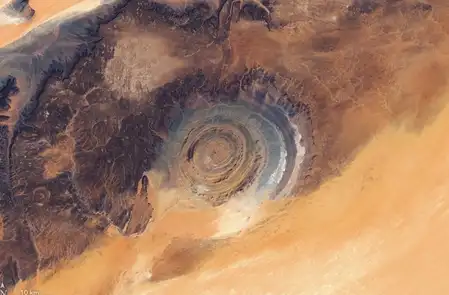
New Delhi, April 18 (IANS). A mysterious circular structure located in the middle of the Sahara Desert has puzzled scientists for decades. Recently, the Earth Observatory of the American space agency NASA has clearly captured this unique geological formation with advanced satellite technology.
This is known as the Richat Structure or ‘Eye of the Sahara’. It is located in the country of Mauritania in north-western Africa. This structure is approximately 40 kilometers in diameter and when viewed from above looks like a giant bull’s eye or buttonhole. At first it was mistakenly thought to be a crater created by a meteorite impact, but later research proved that it was the result of a natural geological process.
Recent images taken by NASA’s Landsat 8 and 9 satellites in March 2026 have shown this structure more clearly. Colorful sand dunes, deep valleys and dry river streams are also visible nearby. The formation is a spectacular example of the geologic forces that shape the Earth’s surface—such as uplift, erosion, and igneous activity. This NASA photo is not only useful for scientists, but also connects common people with the amazing history of the Earth.
Scientists say that the Richat structure is formed in the form of a raised geological dome. Millions of years ago, igneous material came up from underground, causing rock layers to rise upward. Over time, wind, water, and erosion have worn away these layers at different rates. This led to the formation of concentric ridges extending outwards from the centre, called ‘cuesta’. Orange, brown and other colors represent different types of sedimentary and igneous rocks. There are older rocks in the center, while younger layers appear at the outer edges. The entire process took millions of years. Today the structure offers a unique sight in the vast Sahara desert.
The Richat Formation is located on the Adrar Plateau in northern Mauritania. The area is full of Palaeolithic stone tools, Neolithic cave paintings and remains of ancient caravan routes. This structure is not very clear when seen from the ground, but it is clearly visible from space.
French geographers first named it ‘Richat Buttonhole’ in the 1930s. NASA astronauts Ed White and James McDivitt photographed it during the 1965 Gemini IV mission, after which it became known around the world as the ‘Eye of the Sahara’.
–IANS
MT/DKP