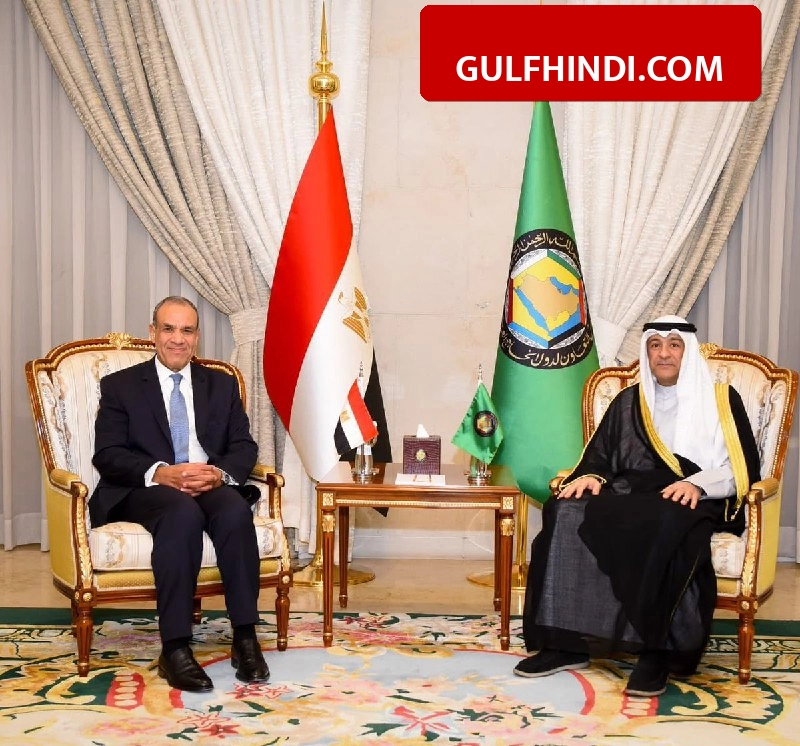
Following the increasing military tension in the Gulf countries and the recent missile attacks by Iran, an important meeting has taken place between Egypt and GCC (Gulf Cooperation Council). This meeting was held on 16 March 2026 in Riyadh, the capital of Saudi Arabia. Egyptian Foreign Minister Dr. Badr Abdellatty and GCC Secretary General Jassim Mohammed Albudaiwi discussed in detail the ways to maintain the security and peace of Arab countries. The main objective of this conversation is to stop the ongoing crisis in the region and ensure the security of international sea lanes.
Important decisions and strategies taken in the meeting
In this high-level meeting, many security policies were discussed which are directly related to improving the situation in the Gulf countries. Officials of both the countries have talked about working together on the security front.
The Egyptian Foreign Minister made it clear that the security of the Gulf countries is an integral part of the national security of Egypt and the entire Arab world. In the meeting, emphasis was laid on implementing the Arab League Common Defense Treaty of 1950 and creating a Joint Arab Force so that the coming threats could be dealt with. Special focus was placed on ensuring safe movement of merchant vessels in the Red Sea and the Strait of Hormuz. To continuously strengthen mutual cooperation, the Joint Action Plan for 2024-2028 was re-affirmed.
Impact on business and public safety
These attacks happening in the Middle East are having a direct impact on international business and common citizens. Due to attacks on sea routes, the income from important routes like Suez Canal has reduced. Egypt told officials that the Suez Canal had suffered a major loss of $9 billion in revenue. In view of these circumstances, both sides have stressed the need to stabilize the Red Sea Corridor so that global trade does not get disrupted.
Furthermore, the GCC leadership praised Egypt’s decision to oppose any plan to displace Palestinians. This meeting is very important for the expatriates and residents working in the Gulf countries as it provides assurance of security and stability in the entire region.