Russia kept asking Taliban to increase its influence, but New Delhi kept turning its back, but what is the reason for suddenly increasing the conflict with Afghans?
When Aamir Khan Muttaki reached India and the Indian government extended its warm arms to welcome him, even the diplomatic fraternity was surprised. After all, this was a wonderful diplomatic irony. For years, New Delhi has avoided the Taliban, considering it a brutal, fundamentalist force. It has been held responsible for several attacks on Indian interests in Afghanistan, including two deadly attacks on the Indian Embassy in Kabul, in which a young IFS officer, India’s defense attache, was killed. Yet, as soon as Muttaki stepped off the plane on October 9, years of silence and bitterness were replaced by a new chapter in New Delhi’s Afghan policy.
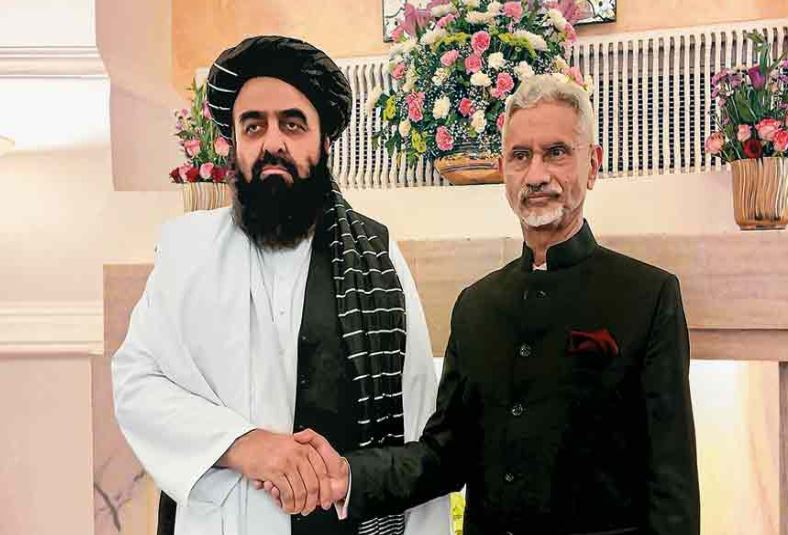
Muttaki met External Affairs Minister Subrahmanyam Jaishankar in the afternoon and stressed on taking the relations forward. Like the rest of the world, India also does not give formal recognition to the Taliban government. Actually, Muttaki also has UN sanctions. New Delhi had to make special efforts to obtain permission from the UN Security Council’s Sanctions Committee for his week-long visit to India.
With the visit of the Afghan Foreign Minister, India has converted its “technical mission” in Kabul into a full-fledged embassy. This is an indication that New Delhi is ready to increase its presence in that country. However, this does not mean that India has recognized the Taliban government.
The international community has not recognized the Taliban government due to the Taliban’s anti-women attitude, its disregard towards minorities and the lack of representation of both. However, all this has had no impact on the fundamentalist orthodox clerics who occupy Afghanistan. The condition of women in that country is getting worse day by day. Women are deprived of education, cannot leave the house without a male escort, cannot accompany men to workplaces, are banned from going to public places and can no longer even work in the health sector, where they used to be in large numbers as nurses, doctors and other people.
Muttaki in Deobandh
This anti-women attitude came to the fore in Delhi too, when Indian women journalists were not invited to Muttaki’s press conference with Indian media at the Afghan Embassy. But as opposition to this increased, he was later called to another press briefing.
Nevertheless, it seems that democratic India is now making every effort to woo the Taliban and a generous development package has also been announced.
In his inaugural address at the bilateral meeting with Muttaki, Jaishankar said, “Your visit is an important step in furthering our relations and reaffirming the enduring friendship between India and Afghanistan.” The two had previously spoken on the phone, but as Jaishankar stressed, “This meeting between us has special significance as it gives us an opportunity to exchange views, identify common interests and build closer cooperation.”
India announces six new health projects in Afghanistan. Furthermore, “The gift of 20 ambulances is another gesture of goodwill and I would like to personally hand over five of them to you as a symbolic step. India will also provide MRI and CT scan machines to Afghan hospitals and will also deliver vaccinations and cancer medicines. We have also provided pharmaceutical supplies through UNODC and stand ready to do so in the future.”
The Taliban repaid India’s generosity by inviting Indian companies to explore mining opportunities in Afghanistan. Jaishankar said the move is “greatly appreciated”. Afghanistan is said to have huge reserves of minerals like copper, iron, gold, lithium and rare earths, whose estimated value is trillions of dollars. Most of them have not been exploited yet. China certainly already has a large copper mining project.
However, the good news for Afghan students is that New Delhi is now ready to give them more visas. Soon after the Taliban came to power, India stopped issuing new visas and students faced difficulties in getting old visas extended. There will be more opportunities available for Afghan students in Indian universities, and businessmen and those seeking medical assistance will also be able to easily get Indian visas.
While the Taliban government condemned the terrorist attack in Pahalgam, New Delhi did not miss the opportunity to express its gratitude to Kabul. Jaishankar spoke to Muttaki on phone for the first time. India has also taken care to continue the flow of humanitarian aid to the Taliban following the recent devastating earthquake.
The reason for the rethink in South Block was the fact that India’s relations with its arch adversary Pakistan have deteriorated rapidly since the Taliban came to power in August 2021. The Taliban’s denial of women’s rights has been ignored in the pursuit of pragmatic politics.
Strategic calculations played an important role in increasing New Delhi’s relationship with the Taliban. The “friendship” between China and Pakistan is largely the reason for this.
It is also a fact that India had very good relations with both the governments of Hamid Karzai and later Ashraf Ghani during the last 20 years. In fact, Kabul and Delhi regularly speak out in unison against Pakistan’s encouragement of terrorism in both countries. “We must coordinate efforts to counter terrorism in all its forms and manifestations. We appreciate your sensitivity to India’s security concerns. Your solidarity with us after the Pahalgam terrorist attack was remarkable,” Jaishankar told Muttaki during his conversation.
For a long time, even after the agreement between the US and the Taliban in 2019 and several countries holding talks with their representatives in Doha, India maintained restraint and avoided recognition. Having good relations with the government of former President Ashraf Ghani, India did not want to go against him. Even after its close friend Russia requested India to start talks with the Taliban, New Delhi stayed away from it. However, now all this is a thing of the past. Now the emphasis is on deepening relations with the Taliban government of Afghanistan.