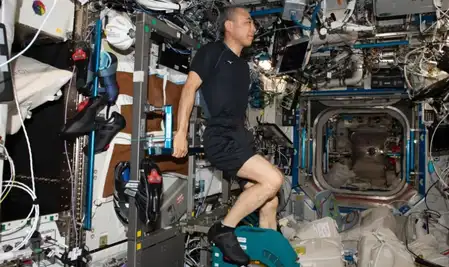
New Delhi, March 8 (IANS). It is not easy to live in space and there is negligible gravity, which is called microgravity. Because of this, the bones and muscles of astronauts start becoming weak. Walking on the earth every day puts pressure on bones and muscles, which keeps them strong. At the same time, such pressure is not available in space, hence bones can become weak by 1 percent every month and muscles shrink and become weak.
In such a situation, if no action is taken, then in a long mission the bones and muscles of astronauts may become weak like the elderly. To deal with this problem, astronauts exercise on an average of two hours daily at the International Space Station (ISS). This exercise is very important for them, because it prevents bone and muscle loss to a great extent. In the early missions, exercises were done only with elastic bands, but now the equipment has become very advanced. American space agency NASA gives detailed information about the main instruments-
Advanced Resistive Exercise Device was installed in the year 2008, this device makes it feel like lifting weights. Its piston and flywheel system provides resistance up to 600 pounds. Astronauts do exercises like squats, deadlifts and bench press with it.
The second is the T2 treadmill, in which the astronaut is tied to the belt with a harness and bungee so that they do not fly away. This provides exercise by running or walking fast.
Cycle Ergometer with Vibration Isolation and Stabilization Installed in the year 2001 and upgraded in the year 2023, this is a cycle machine which provides accurate workload, shows heart rate and speed through computer control.
These devices keep vibrations isolated so that the space station does not move. Astronauts perform both aerobic (running, cycling) and resistance (weight lifting) exercises. Earlier, exercise was done at low speed and for a long time, but now high-intensity, short duration exercise has proved to be more effective.
According to a study, high-intensity, low-volume exercise improves muscles and bones and also saves time. This gives crew members more time for other mission tasks. A type of test, VO2max, revealed that the ability to absorb oxygen decreases during long spaceflights, so it is necessary to improve exercise.
The study also revealed that pre-flight training improves performance in space. Muscle biopsies revealed changes at the molecular level, showing that the current exercise program largely protects muscle. However, every astronaut’s response is different. There are challenges like less space in the space, repair of equipment and heat and humidity.
–IANS
MT/Piyush