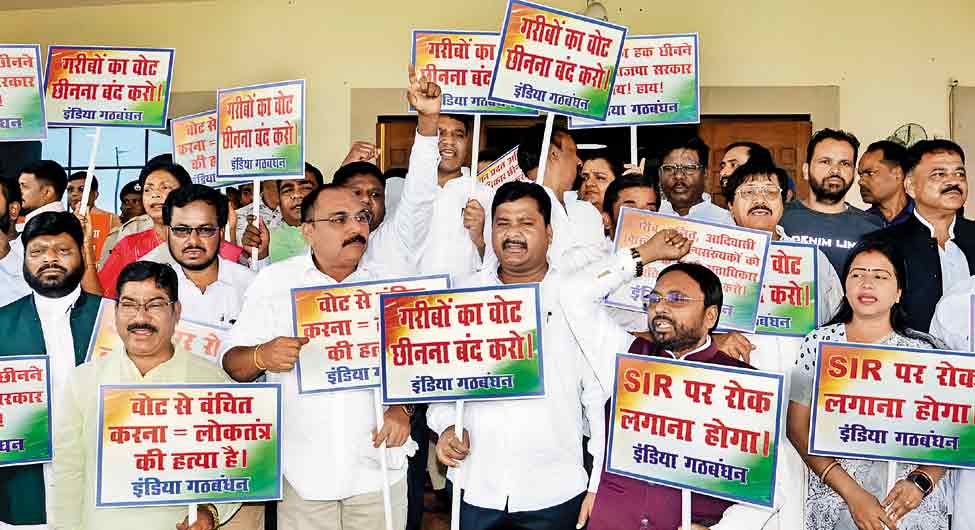
On the pretext of SIR investigation, there is an atmosphere of panic and confusion due to the noise of removing names of 12 lakh voters in the state.
In Jharkhand, the names in the voter list are being checked on the basis of the existing names of the older generation. The emphasis on revealing ancestral identity has led to dissatisfaction among voters. The main reason for this is that the names of many voters included in the voter list of 2024 are not found in the list of 2003. Many people are in danger of being left out of the list due to the 2003 list being considered an important criterion for name verification. Saud Alam Khan is also one such voter. Neither his nor any of his family members’ names appear in the SIR (Special Intensive Review) roll of 2003. Alam Khan, 35, a resident of Doranda, Ranchi, fears that his and his family’s name may be removed from the voter list. He says, “We voted in 2024, now the Booth Level Officer (BLO) is asking us to find names in the 2003 list. I went through the entire list, but we couldn’t find the names anywhere. BLO says we have to ‘find’ our name. Where do I find something that doesn’t exist?” Saud claims that his family has been a ‘Khatiyani’ family in Jharkhand for four generations. Yet, his names, his father Mohammad Shamim (65), mother Shahnaz Begum (55), uncle Mohammad Nesar (62) and 22 other relatives do not figure in the 2003 voter list.
At present his concern is his sister living in Bengal. His brother-in-law is calling him daily asking for a copy of the 2003 SIR list. Only by the names of Saud’s parents, serial number and booth number included in this list, the name of Saud’s sister will be able to be added to the voter list of Bengal. Saud says that many houses in Doranda have the same problem. This is why he and his friends are planning to contact the Jharkhand Election Commission.
Their concern has increased further after the news of December 3, in which the Election Commission was quoted as saying that the voter list of 2024 is being matched with the list of 2003 to identify the generations. During this process, 12 lakh names have been identified as dead, transferred, absent or duplicate entries.
Jharkhand State Election Commission says that the voters registered in the voter list of 2024 are being matched with the voter list of 2003 to identify the parents. In Milan, about 12 lakh names of the state’s 2.65 crore voters are of persons who are no longer alive, have left that place or have moved out of the state or whose names are registered at more than one booth. The Commission has clarified that only these names will be removed from the voter list. An important question arises from this entire exercise, people whose names are in the 2024 list but not in the 2003 list, then are they also in danger of being removed from the list?
BLO in his own mistake
The entire family of 43-year-old Mohammad Javed of Ranchi is missing from the 2003 list. Still they are not worried. “When SIR starts, the BLOs will tell us what to do,” he says. The names of Javed’s parents, Ayub Ansari (65) and Zubaida Khatoon (58), also do not figure in the 2003 list. They are waiting for SIR to start.
Most voters just know that SIR has not officially started in Jharkhand. The BLO has just told them this much. Till now the BLO has not told them anything about what will be the process for those who are not included in the 2003 list. It has also been said in media reports that SIR has not started yet in Jharkhand.
“We have not been told what to do in cases where the names do not exist in 2003 or exist only in 2024,” said a BLO on condition of anonymity. Some people’s names are there in 2024 but not in 2003, some people’s names are in 2003 but not in 2024.” The BLO said that the names of three people in his own house are not in the 2003 list, including his sister, who is herself a BLO.
Is generation investigation part of SIR?
Outlook spoke to Jharkhand Chief Electoral Officer Ravi Kumar about this. He clarified that generations are being investigated in SIR. It is being seen where the father and grandfather were from. There is nothing confusing about this. He told that there are three phases of SIR. First, pre-amendment activities (which are currently underway in Jharkhand). Second, the enumeration phase in which BLOs go door-to-door and collect data. Third, claims and objections, which have already been completed in Bihar.
Regarding mapping, he said, “If your mapping is successful, it means that your name was present in the list of 2003.” This is equivalent to self-verification. Children’s names are mapped through their parents.
But what about those who are voters in 2024 but did not vote in 2003? In response to this question, Ravi Kumar says, “When the stage of claims and objections comes, such voters will be asked to submit any one of the 12 documents included in the list.” ERO will hear the case and take a decision accordingly.” He assured that no Indian citizen of 18 years of age or above will be deprived of his franchise.
Dispute over 12 documents
During the SIR process in Bihar, there were massive protests over the 12 documents that were included in the list. The BLO argued that only a few of these were normal documents. Ration card was not included in these.
The list given by the Election Commission includes government identity cards issued before 1987, birth certificate, passport, educational certificate, caste certificate (Scheduled/Scheduled/OBC), residence certificate, forest rights certificate, land/house records, family register and NRC. Of these, NRC document is not applicable in Bihar.
lessons from bihar
Initially in Bihar, at least one document from the list was mandatory. Common identity cards like Aadhaar card and Ration card were left out of the list. But then later due to huge resentment of the people, BLO started accepting the forms even without documents. Due to pressure, many BLOs filled the forms without visiting the houses. Many names were removed without verification. Many BLOs admitted that they were ordered to complete the higher numbers as quickly as possible.
Exactly the same situation is being seen in Jharkhand also. “Many names in the 2003 list are wrong or missing,” says a BLO from Sahibganj. Senior officers tell us to leave such matters as they are. That is, they say that do not investigate these voters at all.
illusion of intruders
The BJP has repeatedly expressed concern over alleged Bangladeshi infiltration in Santhal Parganas, especially Sahibganj and Pakur, regarding voter lists. Sahibganj borders West Bengal. For this reason, concerns regarding voter verification increase even more.
Local panchayat chief Ishtiaq explains how voters are classified as “Category A, i.e. names matching the 2003 voter list.” Categories C and D i.e. young voters (18-35) who are not included in the electoral roll of 2003, but whose parents are included in that list. Category B, which includes people above 40 years of age, who should have been included in the voter list of 2003 but are not, and this category or group has the most problems.” He further adds that there are many landless people who do not have the documents mentioned by the Commission.
In Bihar, CPI(ML) general secretary Dipankar Bhattacharya, who strongly opposes SIR, says, “Despite the debate on Bihar SIR in the Supreme Court, the state is blindly replicating Bihar’s half-baked flawed model. BLOs are not able to work, many BLOs are committing suicide. “It seems this process is designed to exclude voters from certain groups.”
In Jharkhand too, SIR investigation is being done exactly on the lines of the experience of Bihar. The same situation of confusion, fear and administrative anarchy exists here also. Here too thousands of valid voters are not able to find their records of 2003. Here also the BLO does not know what will happen next.
If the mapping is successful, it means that your name was present in the list of 2003. This is equivalent to self-verification. Children’s names are mapped through their parents.
Ravi Kumar, Chief Electoral Officer, Jharkhand