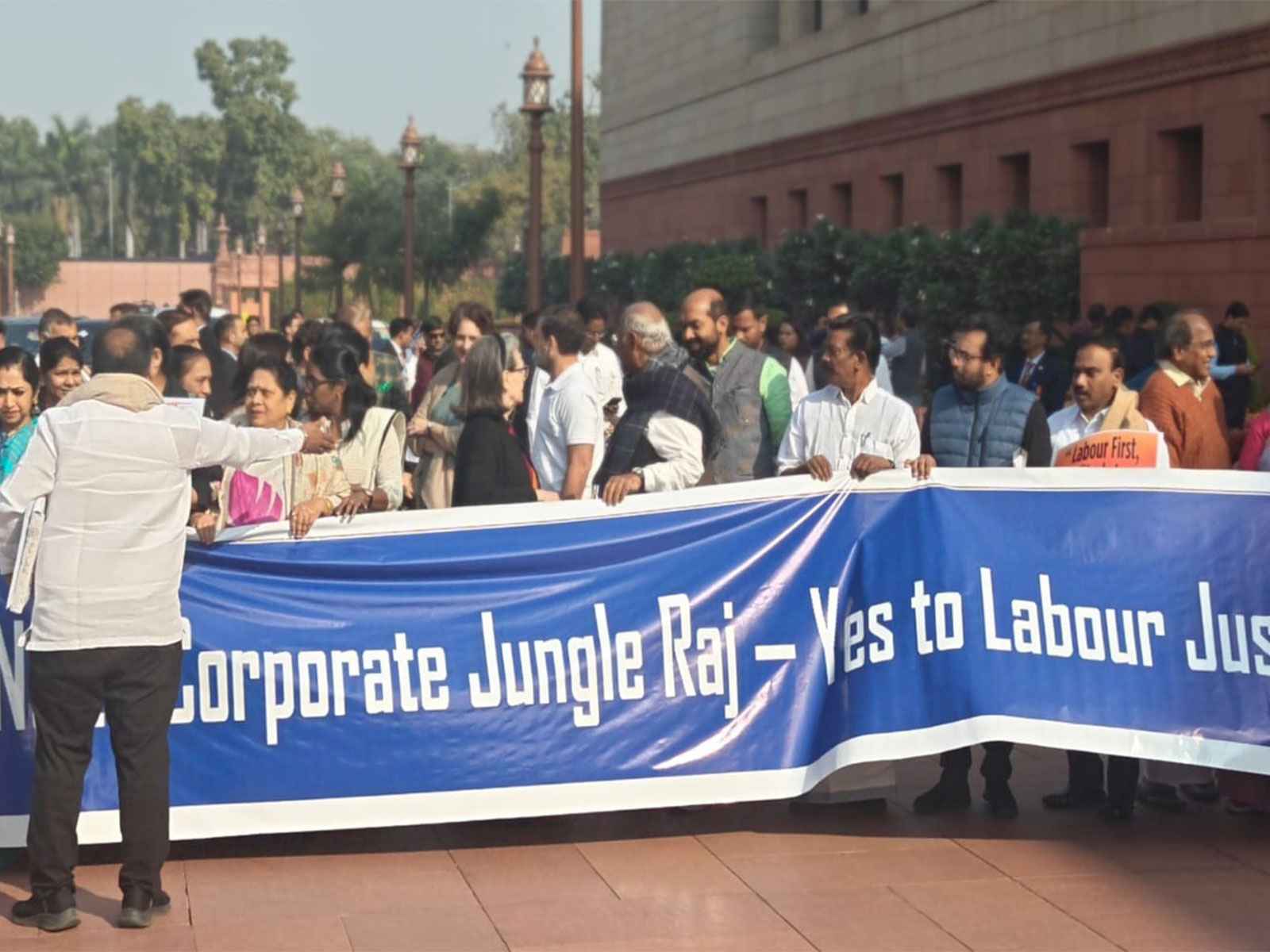
The party’s top leadership, including Congress president Mallikarjun Kharge, legislature party leader Sonia Gandhi, leader of opposition in the Lok Sabha Rahul Gandhi and MP Priyanka Gandhi on Wednesday joined the India Coalition’s protest against the four labor codes in the Parliament complex.
Claiming that all four labor codes promote “corporate jungle raj”, the India Alliance MPs held up various banners, and a large banner read “No to corporate jungle raj – yes to labor justice”.
This protest by India Block came after the government accepted the opposition’s repeated demand for discussion. The central government is going to discuss election reforms on December 9.
India Bloc MPs have been protesting against the Special Intensive Review (SIR) ever since the winter session of Parliament began, and the government is seeking cooperation amid the deadlock in the House.
Earlier today, leaders of the India Alliance held a meeting ahead of the third day of the winter session of Parliament to chalk out strategies after the Center accepted the opposition’s demand for holding a debate on the Special Intensive Revision (SIR) of electoral rolls.
Leader of Opposition in Rajya Sabha and Congress President Mallikarjun Kharge and Leader of Opposition in Lok Sabha Rahul Gandhi were present in the meeting.
Earlier, Parliamentary Affairs Minister Kiren Rijiju said that in the all-party meeting chaired by the Speaker of the Lok Sabha, it was decided to discuss the 150th anniversary of the national song ‘Vande Mataram’ in the Lok Sabha on December 8 and to discuss electoral reforms on December 9.
According to the parliamentary agenda for the third day, Finance Minister Nirmala Sitharaman is likely to introduce the Central Excise (Amendment) Bill, 2025 in the Lok Sabha for consideration and passing.
The bill aims to increase excise duty and cess on tobacco products by amending the Central Excise Act, 1944.
According to the Industrial Relations Code, 2020, trade unions with 51 per cent membership are recognized as negotiating unions. According to the Centre, such an arrangement strengthens collective bargaining.
The Code has also expanded the definition of strike to include “collective casual leave” within its ambit, so as to prevent sudden strikes and ensure legal action.