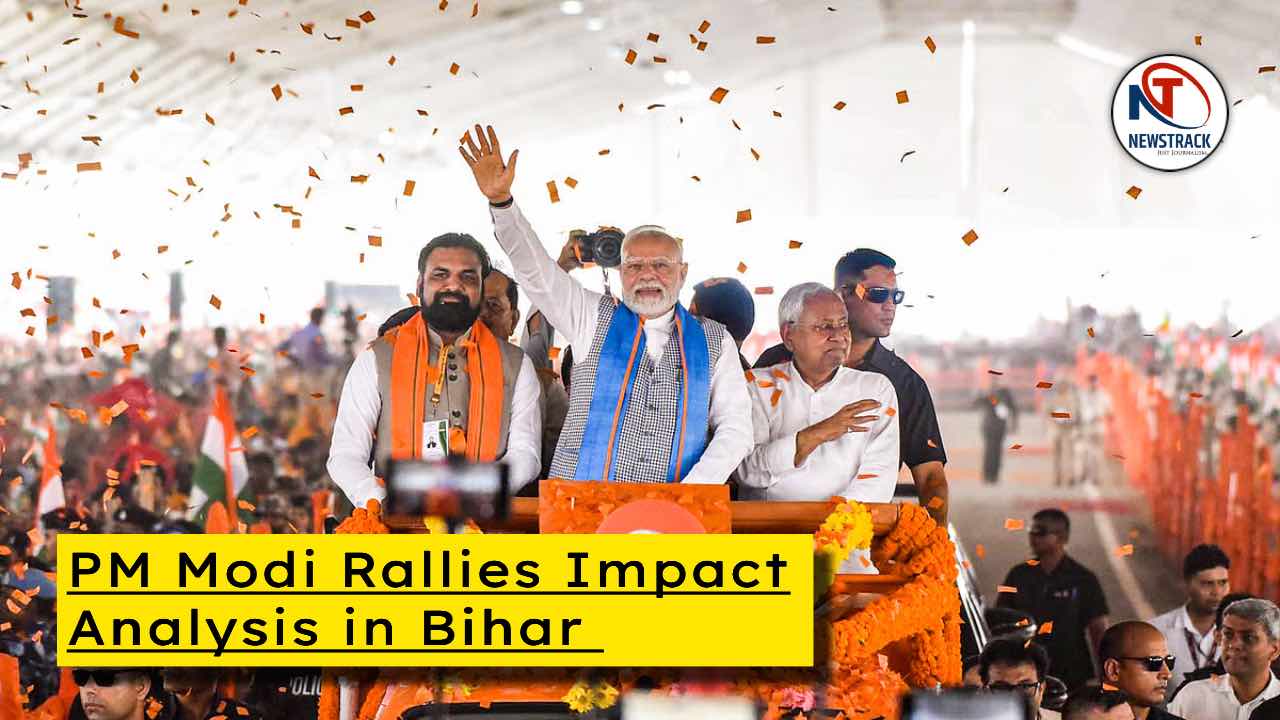
PM Modi Rallies Impact in Bihar Election: The assembly elections being held for 243 seats of Bihar are not just a state election, but it has become a referendum on the policies of the central government and the popularity of Prime Minister Narendra Modi. There is a direct contest in this election between the National Democratic Alliance (NDA) and the Grand Alliance. Prime Minister Modi’s election meetings are the centerpiece of NDA’s campaign. This report analyzes, through some selected, representative seats, what impact these meetings had on candidates from different seats and how the opposition countered it.
1. Valmikinagar: The equation of national vs local
NDA candidates: Sunil Kumar (JDU)
Grand Alliance Candidates: Maheshwar Hazari (RJD)
Valmikinagar, which has a sizeable population of Tharu tribal and Muslim voters, has traditionally been an RJD stronghold. The seat here became the focal point of Modi’s meeting. In his rally, PM Modi attacked the Grand Alliance by using words like ‘Baahubali’ and ‘Delhi ki Sarkar’. Taking credit for the schemes of the Central Government, he talked about the flowing Ganga of development.
Impact of Modi Sabha: The gathering provided a national agenda for local JDU candidate Sunil Kumar. This helped transcend caste equations and tap a broader Hindu vote bank, especially a section of the upper castes and OBCs. Modi’s character created enthusiasm among BJP-JDU voters and played a role in maintaining the voting percentage.
Opposition’s counter strategy: Senior Grand Alliance leader Tejashwi Yadav immediately counter-attacked. He described Modi’s meeting as a ‘pack of lies’ and kept local issues—unemployment, migration, and stalled local irrigation schemes—at the center stage. He stressed that this election is on the issues of Bihar, not Delhi. His strategy was to counter Modi’s national narrative by connecting it to the local ground.
Result: This seat is a close contest. Ultimately, Maheshwar Hazari of Grand Alliance has maintained the lead. This proved that in seats like Valmikinagar, where the social base of the opposition is strong, Modi’s single rally cannot completely break the local leadership and caste alliances. However, the rally made the contest quite difficult.
2. Gaya: The triangle of religion, development and caste
NDA candidates: Prem Kumar (BJP)
Grand Alliance Candidates: Suday Narayan Yadav (anti-JDU faction, supporter of Grand Alliance)
Gaya, being a city of religious importance, has been an important seat for the BJP. PM Modi raised the issue of Ram Temple and nationalism prominently in his rally here. Also, he stressed on the development of infrastructure of Gaya under ‘double engine government’.
Impact of Modi Sabha: Modi’s rally in Gaya strongly united the NDA’s core vote bank (upper caste, Teli, Bania, and Kurmi). Religious issues proved more effective here. This created a positive environment for local BJP candidate Prem Kumar and ensured that the party’s support base did not get scattered.
Opposition’s counter strategy: The opposition did not directly engage in debate on religious issues. Instead, he focused on economic issues. He made the plight of migrant workers, the impact on small businesses, and the decline of local industries during the Covid lockdown an election issue. Their slogan was, “Gaya’s development has stopped.”
Result: NDA’s Prem Kumar won this seat. In seats like Gaya, where BJP already has a strong social base, Modi’s rally acted as a ‘catalyst’. This mobilized voters and made it difficult for the opposition to win.
3. Hajipur: Caste equation vs good governance
NDA candidates: Nitish Kumar (JDU)
Grand Alliance Candidates: Ajit Sharma (former BJP ally, Grand Alliance candidate)
Hajipur, being the seat of Chief Minister Nitish Kumar, is a symbolic center of the entire election. Here PM Modi raised Nitish Kumar’s model of ‘good governance’ and development with full force. He described the alliance of Nitish Kumar and BJP as essential for the progress of Bihar.
Impact of Modi Sabha: The biggest impact of this rally was that it spread unity among the workers of JDU and BJP. By personally expressing his support for Nitish Kumar, Modi gave the message that the alliance will not break. This did not allow rumors of a rift in the alliance being spread by the Grand Alliance to spread.
Opposition’s Counter Strategy: The opposition directly attacked the claims of good governance in Hajipur. He highlighted the poor condition of roads, the problem of floods, and the challenges faced by the youth. Their aim was to tarnish Nitish Kumar’s image as a ‘development man’ and show that the model of good governance is no longer working.
Result: Nitish Kumar has completed the task of registering victory from Hajipur. Here Modi’s meeting held a ‘shield’
Did the work of. This strengthened the coalition’s cohesion and counter-balanced the local discontent that had emerged against the Chief Minister with the support of the national leadership.
4. Dinara: Arena of backward class politics
NDA candidates: Laxman Prasad (BJP)
Grand Alliance Candidates: Jaikumar Singh (RJD)
Seats like Dinara are an example of the complex politics of backward class of Bihar. Koeri and Kurmi castes dominate here. In his speech, PM Modi mentioned the central government schemes for the upliftment of backward classes, such as Mudra Loan and Ujjwala Yojana.
Impact of Modi Sabha: The rally targeted voters from backward classes who are associated with economic empowerment. The BJP’s aim was to attract Koeri votes (which were traditionally with JDU). Modi’s presence boosted the image of the local BJP candidate and gave him a national identity.
Opposition’s Counter Strategy: RJD worked on strengthening its traditional caste alliance (Yadav-Muslim) here. Also, he made the demand for caste census a major issue. His allegation was that NDA talks about the rights of backward classes, but is afraid of revealing their real situation through census. It was a strong counter.
Result: Jaikumar Singh of Grand Alliance is seen ahead on this seat. This shows that where straightforward caste equations prevail, a Modi rally is not capable of completely shifting caste allegiances. However, it did make the competition quite tough.
Overall analysis and conclusions
Prime Minister Modi’s meetings had a multi-layered impact on Bihar’s electoral scenario:
Agenda Setting: Modi’s speeches set the topics for the election debate. The opposition often had to spend time responding to the issues he raised (e.g. Pakistan, nationalism).
Mobilization: These meetings became the center of energy for NDA workers and supporters. They will work to bring people to the booth on the day of voting.
Decisive role in close fight: In those seats where the contest was close, Modi’s character and the national narrative he presented has ensured victory in favor of the NDA by generating a swing of 2-3%.
However, the Bihar election also proves that Modi’s rallies are not a ‘silver bullet’. Where the social base of the opposition was strong and well organized (e.g. Valmikinagar, Dinara), local issues and ethnic loyalties largely negated the influence of the national leadership.
The opposition’s success lay in the fact that they adopted a clear, two-pronged strategy: on the one hand, young leaders like Tejashwi Yadav were strengthening their base by emphasizing local issues (jobs, education) and caste equations (census), while on the other, they were trying to limit Modi’s influence by providing immediate factual rebuttal to every claim of Modi through social media and press conferences.
ultimatelyThe results of Bihar elections showed that both national leadership and local equations have their place in Indian democracy. Prime Minister Modi’s rallies were a powerful force for the NDA, but on the ground in Bihar, the flow of local rivers proved equally powerful.
Prime Minister Narendra Modi’s election rallies in Bihar were a major part of the election campaign of the NDA (BJP, JDU, LJP etc.). The purpose of these meetings was to promote NDA candidates and attract voters. However, it is difficult to measure the exact and quantified impact of these gatherings on election results, as many factors simultaneously influence an election outcome.
Nevertheless, some points can be discussed based on reports and political analysis:
Where and how was the impact of Prime Minister Modi’s meetings?
1. Positive impact on NDA’s strong seats:
In seats where the NDA (BJP/JDU) was already strong, PM Modi’s meetings boosted voter enthusiasm and helped maintain the voting percentage. For example, his meetings in areas like West Champaran, East Champaran, and Saran worked to create an atmosphere in favor of the NDA.
2. Role in “Close Fight” on pressurized seats:
There were some seats where competition was high and the results came by small margins. PM Modi’s rallies in such seats may have played an important role in giving “margin of advantage” to NDA candidates. The election campaign run on Modi’s character and the schemes of the central government seemed to work beyond party equations.
3. Setting the themes:
These meetings decided the election agenda. In his speeches, PM Modi emphasized nationalism, Ram Mandir, central government schemes (like housing, tap water, double engine government) and the “negativity of the opposition”. This put the opposition in a defensive position and forced them to answer on these same issues.
4. Limitations of seat-specific bearing:
It would be wrong to assume that every assembly directly won the seat in that area. Caste and local equations are very strong in Bihar. The popularity of local candidates and ethnic alliances in many seats limited the influence of the national leadership. For example, the Grand Alliance was successful in some seats, which shows that local factors were no less important.
What did the opposition do to counter the impact of Modi’s meetings?
The opposition, especially the grand alliance (Rashtriya Janata Dal, Congress, Left parties, etc.) adopted several strategies in response to PM Modi’s meetings and speeches:
1. Focusing on local issues:
The opposition raised local issues like unemployment, migration, poor education-health conditions, and agricultural distress in Bihar. His argument was that the Central Government has not paid enough attention to the development of Bihar. Tejashwi Yadav reiterated the promise of “10 lakh jobs” and made “unemployment” the main issue.
2. Strengthening caste equations:
The Grand Alliance emphasized on tapping into its traditional caste vote bank (MY-Muslim-Yadav) and making inroads into the Other Backward Classes (OBC) and Extremely Backward Classes (EBC). He raised questions on BJP regarding census and reservation.
3. Challenging the claim of “double engine government”:
The opposition said that despite having a “double engine government”, Bihar is lagging behind in development. He accused the BJP-led governments at the Center and the state of not giving Bihar its due.
4. Immediate response through press conferences and social media:
The opposition immediately responded to the issues raised in PM Modi’s speeches (such as the allegation of changing the Constitution). Opposition leaders, including Tejashwi Yadav and Rahul Gandhi, spoke through press conferences and social media and accused the BJP of “spreading lies”.
5. Counter round of rallies and road shows:
Opposition leaders also held mass rallies and road shows. Although his rallies did not get as much coverage as PM Modi’s, he worked to mobilize his supporters and present his case.
conclusion:
Prime Minister Modi’s meetings act as a force multiplier for the NDA. He generated enthusiasm among NDA voters, set the election agenda and made gains in hotly contested seats. However, due to the complex socio-political structure of Bihar, his influence could not prove decisive on every seat. The opposition tried to counter this effect by focusing on local issues, ethnic equations and quick reactions. Ultimately the electoral outcome was the result of a complex interaction of all these factors.