: Sunday, July 19, 2026 6:22 PM
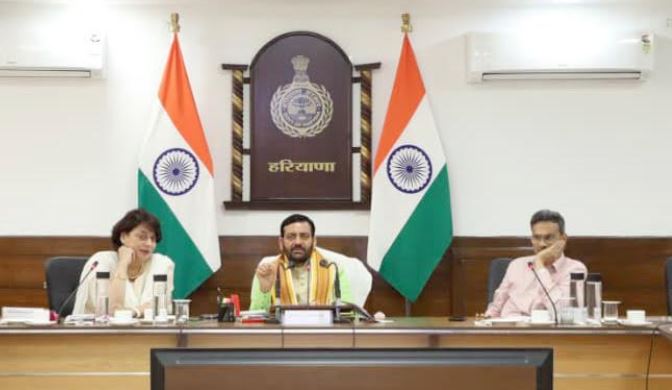
Chandigarh. Haryana Chief Minister Nayab Singh Saini reviewed the progress of digital governance, modernization of land records and citizen-centric reforms while reviewing the work of the Revenue and Disaster Management Department at Haryana Niwas Chandigarh on Sunday. He directed the officers that every service of the Revenue Department should be made transparent, technology based and within the stipulated time limit so that the citizens can get easy services without any unnecessary delay. All the District Deputy Commissioners, DMC and senior officials of the state were present in the meeting. In the meeting, Additional Chief Secretary and Financial Commissioner, Revenue and Disaster Management Department, Dr. Sumita Mishra informed that the department took an important step towards comprehensive digital transformation by setting up its first in-house Information Technology (IT) division in May 2025. This has reduced dependence on external agencies and accelerated the development and maintenance of departmental digital platforms. This technical team consists of 16 sanctioned posts including software developers, UI/UX designers, technical documentation experts and system administrators. The Chief Minister reviewed the progress of the Integrated Revenue Portal. He was told that this portal has been developed as an integrated digital platform for citizens and departmental officials. Through this, online revenue services are being provided to the citizens. The portal also features a single sign-on system for officers and an integrated dashboard for real-time monitoring of service delivery and pending cases.
Instructions given to make the revenue grievance redressal system more transparent
While reviewing the grievance redressal system, the Chief Minister directed the officials to make it more transparent, accountable and citizen friendly. He said that every eligible citizen should get justice. Applicants whose applications have been rejected and if they are not satisfied with the decision, should be given a fair opportunity for reconsideration.
Reviewing the complaint dashboard, the Chief Minister directed that complete transparency should be maintained in the disposal of all applications. In every rejected application, clear reason for rejection should be recorded and proper record should be maintained. He directed the officers to conduct random checks of rejected cases from time to time so that no eligible person is deprived of benefits due to procedural error or wrong investigation.
The Chief Minister directed all the Deputy Commissioners to ensure participation of Tehsildars and other officials of the Revenue Department in the weekly solution camps being organized in the districts so that it is possible to solve the revenue related problems on the spot.
Land records will be modernized in mission mode
While reviewing the land records modernization program of the state, the Chief Minister took information about its progress. He was told that till now more than 40.20 crore old revenue records have been digitized, due to which digital land records have become available in the state.
Around 44 thousand square kilometer area has been covered through drone survey, while 19 Continuously Operating Reference Stations (CORS) have been established to strengthen the geospatial infrastructure of the state.
It was informed in the meeting that geo-referencing work of maps of 99 percent villages of the state has been completed. About 60 lakh Tatima maps have been updated and about 60 percent of the Record of Rights has been standardized. First level verification of more than 99.5 percent of the digitized records has also been completed. The Chief Minister directed the officials to complete the land records modernization program within the stipulated time limit.
The meeting was informed that under the citizen-centric reforms, property cards have been prepared and distributed to about 25.16 lakh property owners in 6,761 villages. Maps of about 95 percent villages have been uploaded on the Bhu-Naksha portal. To increase transparency and authenticity, about 42 lakh Aadhaar numbers have been linked to old revenue records and an IT helpdesk has also been set up for the convenience of citizens.
Officials said that the department has disposed of more than five lakh pending mutation cases. About 80 percent of the services of Saral Portal have been linked to the Auto Appeal System so that cognizance of cases pending beyond the stipulated time can be taken automatically at the higher level and timely delivery of services is ensured. Digital registration reforms have resulted in revenue collection of more than Rs 15 thousand crore.
The Chief Minister directed the Deputy Commissioners to regularly monitor the paperless document registration system. Officials said that the process of document registration has now become completely end-to-end paperless and a public live dashboard is also available to monitor the pending cases.
Better facilities should be ensured for citizens in all land registration offices.
The Chief Minister directed that adequate facilities should be provided to the citizens visiting all the land registration offices. He said that all necessary basic facilities including proper waiting room should be available in every office. Also, queue management system should be implemented in all offices and token numbers should be displayed on digital screens so that citizens can get services in a systematic and convenient manner.
Dr. Yashpal, Project Director of Chief Minister Good Governance Associate Program (CMGGA), said that under the paperless system, more than 12,300 applications have been received so far on the digital platform. Districts are being regularly monitored for verification of data of geo-referenced villages so that land demarcation can be made more accurate and transparent. Appreciating the work of Sirsa district in quick diagnosis of such cases, the Chief Minister directed other districts to adopt the methodology of better performing districts.
It was told in the meeting that the work of linking revenue records with Aadhaar is also going on at a fast pace. So far, out of total 1.69 crore records, more than 42.55 lakh records have been linked to Aadhaar, which is about 25 percent of the total records. This will make land records more accurate, eliminate duplicate entries, increase transparency, speed up services and effectively stop fake land transactions.
Instructions to extend Agri Stack registration till 15th August
The progress of Agri Stack Farmer Registry was also reviewed in the meeting. The Chief Minister instructed the Deputy Commissioners that a comprehensive public awareness campaign should be conducted for farmers to get Agri Stack ID made. He said that a significant increase in farmer registration should be ensured by August 15 so that more and more farmers can take advantage of future digital agriculture initiatives and government schemes.
The Chief Minister also reviewed the preparations for the digital crop survey. Officials said that a target has been set to cover all the villages of the state 100 percent in the upcoming crop season. For this, data verification, training of master trainers, capacity building at the district level, preparation of mobile app, mock survey and statewide survey will be started from mid-August. The survey will also be completed and audited by the end of the year. The Chief Minister also reviewed the pending cases of offline Jamabandi and the progress of rationalization of Patwar Circles.
It was also informed in the meeting that the department has prepared detailed operating procedures (SOPs) and user manuals for various digital modules including Aadhaar seeding, auto mutation, certified copies, demarcation, loan entries and user registration to ensure uniform implementation across the state.
Review of Ayushman Bharat and Viva Haryana Scheme*
During the review of Chief Minister Good Governance Associate Program (CMGGA), the Chief Minister reviewed the progress of Ayushman Bharat and Viva Haryana Scheme in the state. He directed the Deputy Commissioners to link every eligible beneficiary with these schemes so that no needy family is deprived of the benefits of cashless health services.
The Chief Minister said that at least one government hospital in every district should be equipped with modern facilities, quality health services and necessary medical resources at par with private hospitals. He said that government hospitals should set the highest standards of cleanliness, patient care and service delivery. He directed the Deputy Commissioners to conduct regular surprise inspections of government hospitals and personally monitor the availability of doctors, medicines and testing facilities.
Chief Secretary Anurag Rastogi, Principal Secretary of School Education Department Vijay Singh Dahiya, Commissioner and Secretary of Urban Local Bodies Department Ashok Kumar Meena, all Deputy Commissioners, Municipal Corporation Commissioners and other senior officers were present in the meeting.
Read this also – Click to read the news of your state/city before the newspaper.
Web Title-Digital transformation in the Revenue Department ensures transparent, effective, and citizen-centric services: Nayab Singh Saini