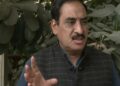
Prime Minister Narendra Modi on Sunday announced the implementation of the next generation of goods and service tax (GST) reforms from 22 September, which he described as a major step towards the self -sufficient Bharat Abhiyan. Addressing the nation before the implementation of GST, Prime Minister Modi said that these reforms will introduce the nationwide “GST savings festival”, which will be the poor, middle class, farmers, traders and entrepreneurs.
Addressing the nation before the implementation of GST, Prime Minister Modi said that these reforms will start the nationwide “GST savings festival”, which will benefit the poor, middle class, farmers, traders and entrepreneurs. “Since sunrise on the first day of Navratri, the nation is taking another important and big step towards the self -sufficient Bharat Abhiyan on the first day of Navratri. The GST reforms will be implemented. “The Prime Minister said that the poor, middle class, farmers, women, traders and entrepreneurs of the country will all be” benefited “with increased savings and easy shopping.
He said, “From tomorrow, ‘GST Savings Festival’ is starting across the country. Your savings will increase in this GST savings festival and you will be able to buy your favorite things more easily. Poor, middle class, new class, youth, farmers, women, shopkeepers, traders and entrepreneurs – all will benefit greatly.”
PM Modi said, “In this festive season, everyone will have the reason for celebrating and the happiness of every family of the country will increase.” Describing it as a festive gift, the Prime Minister said that these reforms will give momentum to India’s development saga, make business easier, will attract investment and ensure that every state will become equal partners in development.
He said, “When India took the historic step to implement GST in 2017, it started changing an old system and creating a new history. For decades, the people of our country, including all of you and our traders, were trapped in many taxes – octroi, entry, sales, excise, service tax and dozens of other taxes.”
During the 56th meeting of the GST Council earlier this month, the improvement in the Goods and Services Tax was approved, which is scheduled to be implemented from September 22. The current four-rate system will now be replaced by a streamlined two-slab system of 5 percent and 18 percent. A separate slab of 40 percent has been retained for luxury and harmful items.
This new structure is expected to support a wide range of industries easier with this new structure, to reduce consumer prices, promote manufacturing, and from agriculture to automobiles and FMCG to renewable energy, and its purpose is to reduce the cost of life, strengthen MSME, strengthen MSMEs, comprehensive tax base and promote inclusive growth.
In Fast Moving Consumer Goods (FMCG) and dairy sector, major brands like Amul and Mother Dairy have announced a huge reduction in prices, which shows the full advantage of GST cuts. Objects like milk, butter, ghee, cheese, cheese, ice cream, snacks and frozen food have been brought under 5 percent of the slab, due to which items like food have been brought under 5 percent of the slab The price of butter will now be Rs 58 instead of Rs 62 and the price of ultra high temperature milk (UHT) has come down from Rs 77 to Rs 75 per liter.
Mother Dairy has also cut the prices of milkshakes, cheese, ghee and frozen products. One of the most impressive reforms in the automobile sector has been seen. Two -wheelers, small cars and auto parts up to 350 cc have come at the rate of 28 percent at the rate of 18 percent, which has reduced the cost of ownership.
Tractor with a capacity of less than 1800 cc will now be only 5 percent GST instead of 12 percent, while commercial cargo vehicles and buses will also have 18 percent GST. These changes expect an increase in sales of vehicles, benefits to gig workers and farmers, and employment creation in the entire automotive price chain.
In the housing and construction sector, cement has been removed from 28 percent to 18 percent, while essential construction materials such as granite blocks, marble and sand-lime bricks have been placed under a rate of 5 percent. The aim of these changes is to make homes more economical and promote infrastructure development in urban and rural India.
Agriculture has received significant boost, and major agricultural equipment such as harvester, thresher, sprinkler and drip irrigation system has now been imposed only 5 percent tax. Health service and pharmaceutical sectors have also been given priority.
More than 30 life -saving drugs and diagnostic kits have been completely freed from GST, while other essential medicines, including drugs used in traditional systems like Ayurveda and Unani, will have only 5 percent GST. Medical devices such as thermometer, glucometer and correct lens have also been put in lower tax realization, making healthcare more economical for the general public.
The service sector is also not lagging behind. Staying in hotels up to Rs 7,500 per day will now levy 5 percent GST instead of 12 percent, while GST rates on services like gym, salon, barber and yoga center have also come down from 18 percent to 5 percent. In the field of education, equipment like Pencil, Crayon, Rubber and Practice Practices has been completely free from GST. Geometry boxes and other school materials, which used to levy 12 percent earlier, will now come into a slab of 5 percent. Exemption will continue for education and major health services.
Textile and handicrafts industries are also prominent beneficiaries. The reverse fee structure on man -made fibers has been fixed and GST has been reduced to 5 percent on threads and fibers. The Railway Ministry has also announced a decrease in the price of Rail Neer Packaged Drinking Water, under which the price of a liter bottle has now come down from Rs 15 to Rs 14. This deduction will be applicable across the country from 22 September.
The renewable energy sector will benefit greatly by decreasing GST from 12 percent to 5 percent on equipment and parts. The Ministry of New and Renewable Energy estimates that this will reduce the capital cost of large -scale solar projects by Rs 20 to 25 lakhs per megawatt. This can save more than Rs 100 crore for 500 MW solar parks, which will eventually reduce the cost of electricity for homes, businesses and public utilities.
Government sources say that GST rate on essential commodities like soap, shampoo and packaged foods has been reduced to 5 percent, while equipment like AC and big TV has now come in 18 percent slabs, while most of the goods and services now come under two-slab system, luxury and harmful items, such as luxury and harmful items, such as upper-level motorcycles, high-level motorcycles, high-level motorcycles. Boats and aerated beverages, but additional compensation will continue to be taxed at a special 40 percent rate with cess.