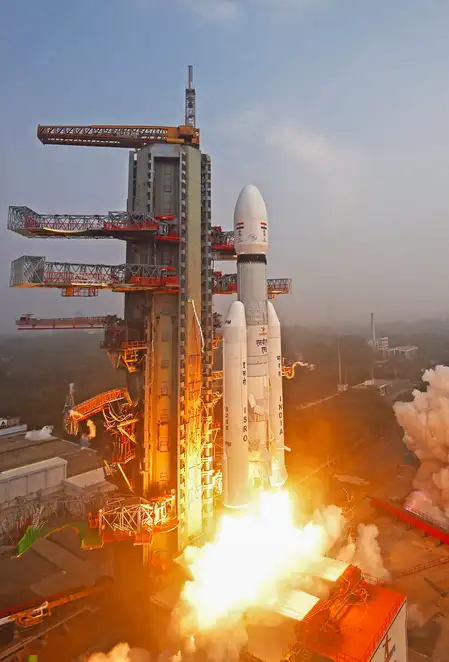
New Delhi, June 21 (IANS). The date of June 22 is recorded in golden letters in India’s space history. This is the day when the Indian Space Research Organization (ISRO) demonstrated its technological capability, credibility and growing global credibility, giving a new introduction to India’s space power to the world. On this day in 2016, ISRO had created a new history by successfully launching 20 satellites simultaneously through its rocket PSLV-C34.
This achievement was not just a successful launch but a symbol of India’s growing strength in the space sector and its acceptance at the global level. At that time, launching 20 satellites in a single mission was considered a major achievement for India.
PSLV-C34 took off at 9.26 am from the Satish Dhawan Space Center in Sriharikota, Andhra Pradesh. The main satellite of the mission was a Cartosat-2 category satellite weighing 727.5 kg. Along with this, 19 co-passenger satellites were also sent into space.
During flight, all stages of the rocket were completed successfully as per plan. Approximately 16 minutes and 30 seconds later, Cartosat-2 was placed in its designated orbit and within the next few minutes all the remaining 19 satellites were also successfully separated. In this way the mission was completely successful.
The most important payload of this mission was the Cartosat-2 category satellite. It was equipped with state-of-the-art cameras, capable of taking high-resolution photographs of the Earth. Through this, important information can be obtained in many areas like urban and rural use, monitoring of road network, water resources management, study of coastal areas, preparation of land use maps and Geographic Information System (GIS). In simple words, this satellite proved to play an important role in everything from development plans to better management of resources.
A special feature of the mission was that the satellite made by Indian students was also sent into space. Students of Satyabhama University, Chennai and Engineering College, Pune had contributed in making these satellites named ‘Satybhamasat’ and ‘Swayam’. The launch of these satellites was also a message that India’s space program is not limited to scientists only, but is also giving an opportunity to young talents to dream big and make them come true.
In this mission, 17 other satellites sent with PSLV-C34 were from Canada, Germany, Indonesia and America. Of these, maximum 13 satellites were from America, while two satellites from Canada, one satellite each from Germany and Indonesia were sent.
It is clear from the success of this mission that India has given a new height to its flight in space and has told the world that its sky is now bigger than ever.
–IANS
DCH/PM