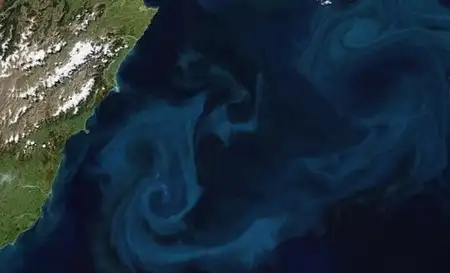
New Delhi, April 4 (IANS). Be it sea or mountains, every corner of the earth holds a mystery within itself. One such mystery is the phytoplankton bloom that shows the amazing sight of the unique play of colors in the sea.
In June 2025, the waters of the North Sea near the Shetland Islands of Scotland suddenly became colourful. This amazing spectacle of green and blue colors was due to a massive bloom of microscopic organisms called phytoplankton. They are so small that they are not visible to the naked eye, but when their number suddenly increases, they become clearly visible even from satellite.
The OLI-2 camera mounted on the Landsat-9 satellite of the American space agency NASA captured a photo on June 13, 2025, in which the bloom area was about 160 kilometers wide. In the pictures taken from satellite, the water appeared green and at some places blue and white.
According to scientists, the green color was mostly due to phytoplankton called diatoms. Diatoms have silica shells and chlorophyll is found in large quantities in them. They thrive in spring, but are sometimes seen in summer as well. The bloom also included phytoplankton called coccolithophores, which have tiny shiny calcium carbonate plates on their shells that give the water a milky or turquoise blue color. This species is common in the North Sea and was previously observed off the coast of Scotland in 2021.
First of all we need to understand in simple way what are phytoplankton? This name, made up of the Greek words ‘phyto’ (plant) and ‘plankton’ (wanderer), is used for micro-organisms. They live in both salt and fresh water. These include cyanobacteria, diatoms, dinoflagellates, green algae and coccolithophores. Most are unicellular. Like terrestrial plants, they create energy from sunlight, which is called photosynthesis. They absorb carbon dioxide and release oxygen. Sunlight, carbon dioxide and nutrients like nitrate, phosphate, silicate are necessary for their growth. Some species can also fix nitrogen. In favorable weather there is an explosive increase in their numbers, which is called bloom. It can spread over hundreds of square kilometers and last for several weeks, although the lifespan of each organism is only a few days.
Phytoplankton are the foundation of the marine food chain. These are the primary producers that provide food for all organisms, from tiny zooplankton to giant whales. Smaller fish eat them, then bigger fish eat smaller fish. These are also very important for the environment. They absorb carbon dioxide through photosynthesis.
Dead phytoplankton sink into the deeper parts of the ocean and carbon remains stored there for a long time. In this way they help in climate control. However, along with some advantages there are also some disadvantages. Some species produce a toxic substance known as ‘red tide’. These can be dangerous for fish and humans. Decomposing dead organisms after large blooms deplete the water of oxygen and create ‘dead zones’ where other organisms cannot survive.
–IANS
MT/AS