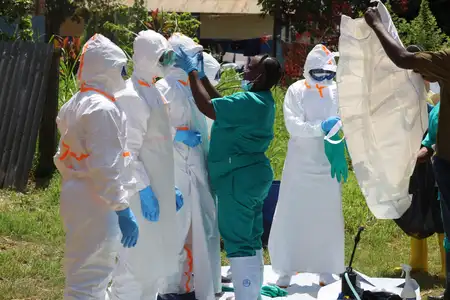
Kinshasa, May 29 (IANS). The Ebola outbreak in the Democratic Republic of Congo (DRC) is ‘very complex’. World Health Organization (WHO) Director-General Tedros Adhanom Ghebreyesus said that efforts to stop the disease are becoming difficult due to the ongoing conflict in the area, insecurity, migration of people, food shortages and distrust among people.
Tedros, speaking to reporters after reaching Kinshasa, the capital of DRC, late on Thursday night, said that he has come here to assure the affected people that ‘they are not alone’ and WHO stands fully behind them to help them.
He said that WHO teams are already working in Bunia, the capital of Eastern Ituri province. He also said that he will go there on Friday and take stock of the situation.
Tedros said that conflict and insecurity are the biggest obstacles to fighting this disease. He again appealed for a ceasefire in view of the armed attacks in the affected areas.
When asked about travel restrictions imposed by some countries on travelers coming from the DRC, he said WHO does not recommend imposing travel restrictions. He said that such steps can slow the infection only for a few days.
“The best approach is to strengthen containment measures and provide support to people where the disease is spreading,” he said.
Tedros warned that travel restrictions could have a negative impact on public health. He said that if a country honestly shares information about the disease and in return sanctions are imposed on it, then in the future the country may be reluctant to provide timely information.
According to the Congolese Health Ministry report released on Wednesday, more than 1,000 suspected cases and 238 suspected deaths have been reported so far in this new outbreak. This disease is continuously spreading in the eastern provinces of the country.
This is the 17th outbreak of Ebola in the DRC. Lab investigation has revealed that this time ‘Bundibugyo’ strain of the virus has been found, which is considered a rare type of Ebola.
WHO declared the outbreak an international public health emergency on 17 May. After this, the Africa Centers for Disease Control and Prevention also declared it a continental public health security emergency.
–IANS
AY/AS