Dalit Vote Bank Bihar: The bugle of the assembly elections in Bihar is over, and both the major alliances- Grand Alliance and NDA- have set their own board in the political ground. The game of ethnic equations is at its peak in this election Mahasangram, but everyone’s eyes are fixed on a vote bank that may have 20 percent of the number, but it has the power to decide the election results. We are talking about the Dalit vote bank of Bihar. Both coalitions are making every effort to help this decisive vote bank, because they know that the one who will go to this vote bank will reach the peak of power. This fight is not only for seats, but also to change the social and political equations of Bihar.
Mathematics of ‘Dalit vote bank’ in Bihar
In Bihar, 20 percent of the total voters come from the Dalit community, including many different castes. The largest population of this vote bank is that of Ravidas society, who holds a 31 percent stake in Dalits. After this, the Paswan community comes second, whose population is 30 percent. At the same time, the third largest population among Dalits is Mushar i.e. Manjhi society, which is 14 percent. The number of these communities is so much in almost every assembly constituency that they can change the result of the election. Out of 243 assembly seats in the state, 40 seats are reserved for Scheduled Castes and Tribes, which is expected to have a tough competition between the two alliances. In the current assembly, 21 out of these 40 seats are occupied by NDA and 17 on the grand alliance.
Grand Alliance’s ‘Dalit Card’ strategy
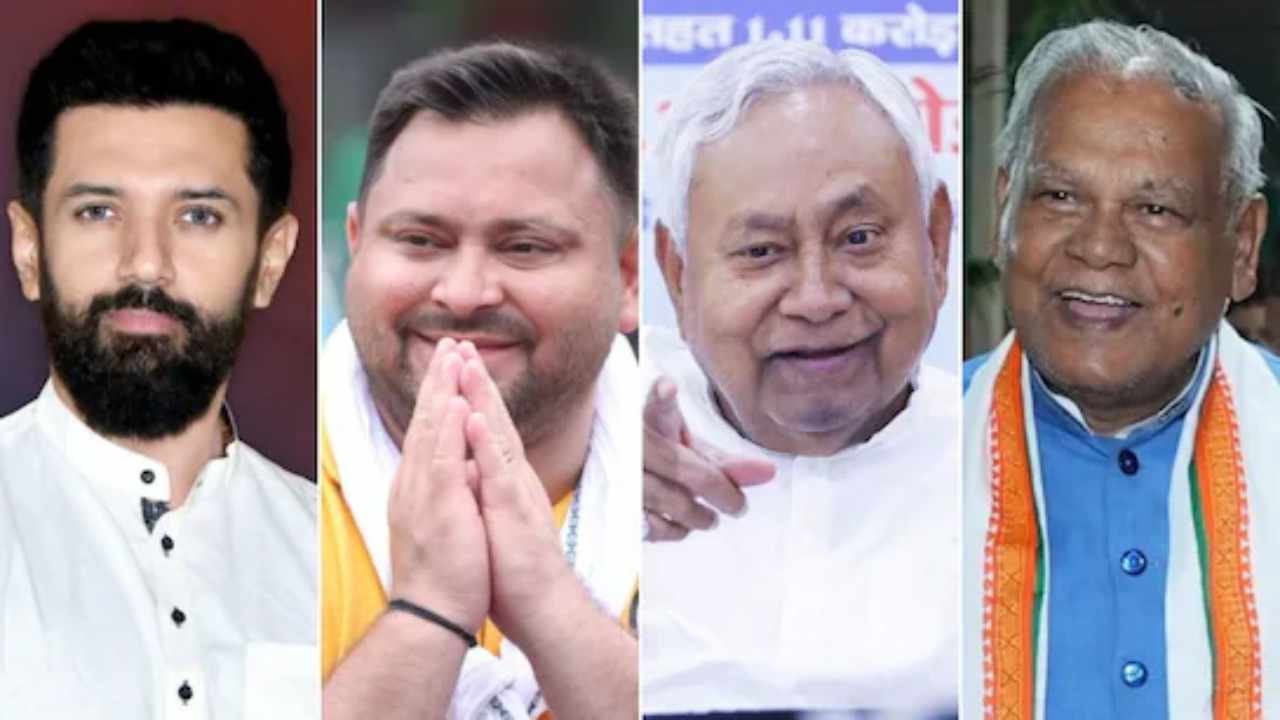
There was a time when the RJD and his supremo Lalu Prasad Yadav were considered strong on the Dalit vote bank, but over time the grip weakened. Now Tejashwi Yadav is trying his best to draw this vote bank back. This time, the Grand Alliance strategy includes many new faces and equations. In the 2020 assembly elections, RJD’s alliance with a Left party like CPI Male was successful, and he benefited from Dalit votes in areas like Shahabad. This experiment was also successful in the 2024 Lok Sabha elections, which has encouraged Tejashwi. Apart from this, the Congress has also taken a big step to help the Dalit vote bank. The party has removed its Bhumihar state president and handed over the command to Rajesh Ram, who comes from Ravidas Samaj. It was also a part of this strategy to hold Rajesh Ram’s hand during Rahul Gandhi’s ‘Water Rights Yatra’.
NDA’s ‘Paswan-Manjhi’ formula
On the other hand, the NDA camp is already in the fray with two big faces- Chirag Paswan and Jitan Ram Manjhi, who came from the Dalit community. The second largest stake after Ravidas society is the Paswan caste, and the vote bank of this community is considered safe with Chirag Paswan. In the 2020 assembly elections, Chirag had caused a big loss to Nitish Kumar’s party by contesting alone, which reduced the JDU 43 seats. This time Chirag is with the NDA, which is a big relief for Nitish Kumar. At the same time, Jitan Ram Manjhi is also included in the Union Cabinet, and the BJP hopes that he will be able to transfer a large part of 14 per cent of the Mushar voters of its community to NDA.
‘Big question’: Will Dalit voters go under whose court?
Both coalitions are making every effort to help the Dalit vote bank, but the real question is, in which court the Dalit voters will go in the election. In some border districts of Bihar, Ravidas voters have still been voting for the BSP, which is a challenge for both Congress and RJD. The NDA has strong faces like Chirag and Manjhi, but will they be able to keep their communities completely with them? The role of Dalit voters in this election is going to be decisive, and it will be interesting to see whose ‘formula’ proves more effective. Only the results of Bihar elections will show that the ‘decisive’ mandate of the Dalit vote bank goes in whose favor.